Introduction
A single missed milestone can trigger liquidated damages, contract disputes, workforce inefficiencies, idle equipment costs, and reputational damage. Studies consistently show that more than 70% of large construction projects experience schedule overruns, often exceeding original timelines by 10–30%.Delays are one of the most expensive problems in construction projects.
When delays occur, project teams face a critical decision: accept the delay and absorb the cost or compress the schedule to recover lost time. This is where schedule compression techniques in construction become essential.
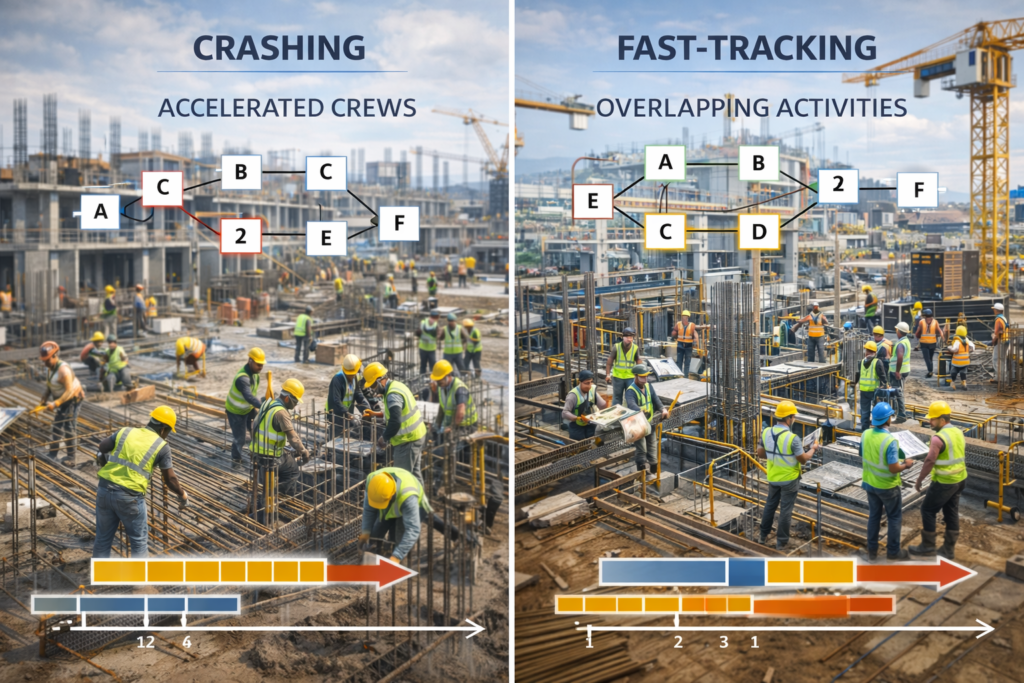
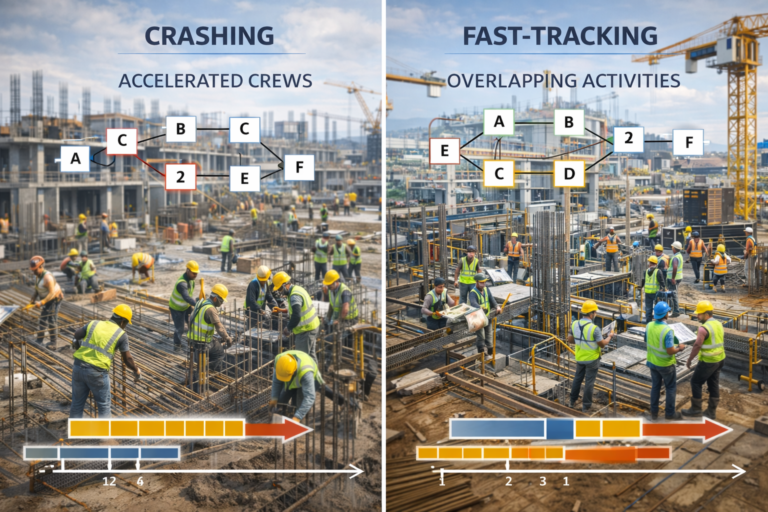
Two professional methods dominate real-world project recovery strategies:
- Crashing – reducing project duration by adding resources and increasing cost
- Fast-tracking – reducing project duration by overlapping activities and increasing risk
While both aim to accelerate delivery, they differ significantly in risk profile, cost structure, quality impact, and contractual exposure. Choosing the wrong method can create more damage than delay itself—causing rework, safety incidents, quality failures, and claims.
This article provides a comprehensive, construction-focused guide to crashing vs fast-tracking. It goes beyond theory and business-school project management and delivers practical, field-tested methodologies you can apply on real construction sites—commercial buildings, infrastructure projects, industrial plants, EPC contracts, and fast-track developments.
You will learn:
- How each method works in real construction environments
- When to use crashing vs fast-tracking
- How to calculate time-cost tradeoffs
- How to manage risk, quality, and safety
- How to implement schedule compression using CPM logic
- How to avoid the most common failure patterns
- How real projects successfully recovered lost time
This is a complete operational guide for project managers, planners, engineers, consultants, and contractors who must deliver projects under pressure.
Table of Contents
1. Why Schedule Compression Matters in Construction
Construction schedules are not just timelines—they are financial control systems. Every day of delay directly impacts:
- Overhead costs (site staff, site offices, utilities, supervision)
- Equipment rental
- Financing interest
- Cash flow cycles
- Subcontractor coordination
- Material storage and deterioration
- Client satisfaction and future contracts
Key Impacts of Delay
- Average indirect cost of delay: 1–3% of project value per month
- Liquidated damages in contracts: typically 0.1%–0.5% of contract value per day
- Idle labor inefficiency losses: up to 20–30% productivity reduction
Schedule compression is not only about speed—it is about financial survival and contractual protection.
Strategic Importance
Schedule compression supports:
- Recovery from design delays
- Supply chain disruptions
- Regulatory approval delays
- Weather disruptions
- Change orders
- Client scope changes
- Contractor productivity losses
Without structured compression strategies, teams rely on chaotic acceleration—leading to burnout, unsafe conditions, and quality failures.
2. Fundamental Concepts of Schedule Compression
H3: What Is Schedule Compression?
Schedule compression is the systematic reduction of project duration without changing project scope, using structured project management techniques.
Two formal methods exist:
- Crashing → Add resources → Increase cost → Reduce time
- Fast-tracking → Overlap activities → Increase risk → Reduce time
H3: Compression vs Acceleration
| Concept | Meaning |
|---|---|
| Acceleration | Informal rushing without planning |
| Schedule compression | Structured, analytical reduction |
| Productivity improvement | Efficiency-based speed gains |
| Scope reduction | Removing work (not compression) |
True compression preserves scope and quality while modifying time, cost, or sequence
Compression Decision Drivers
- Contractual penalties
- Client deadlines
- Seasonal constraints
- Financing timelines
- Market opportunity windows
- Regulatory deadlines
3. CPM Logic and the Critical Path in Compression Decisions
Schedule compression must always start with Critical Path Method (CPM) analysis.
H3: Critical Path Principle
Only activities on the critical path affect project duration.
Compressing non-critical activities does not reduce project completion time.
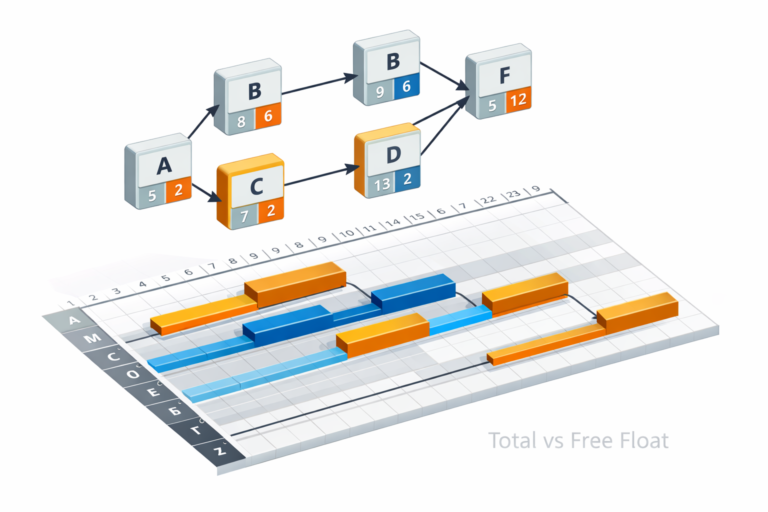
H3: Float Consumption Logic
Fast-tracking consumes float.
Crashing reduces activity duration.
H3: Practical Rule
- Crash critical activities
- Fast-track near-critical sequences
- Protect safety-critical activities
4. Crashing Method: Concept, Structure, and Application
H3: What Is Crashing?
Crashing reduces activity duration by allocating additional resources, increasing productivity through:
- Extra labor crews
- Overtime shifts
- Specialized equipment
- Parallel subcontractors
- Higher-capacity machinery
- Premium logistics
Crashing Techniques
- Double shifting
- Night shifts
- Additional cranes
- Precast components
- Modular construction
- High-speed formwork
- Additional QA teams
Crashing Cost Structure
Crashing increases:
- Direct labor cost
- Equipment rental
- Supervision
- Safety staffing
- QA/QC staffing
- Logistics cost
5. Fast-Tracking Method: Concept, Structure, and Application
What Is Fast-Tracking?
Fast-tracking reduces time by overlapping sequential activities that were originally planned in series.
Example:
- Start MEP rough-in before structure completion
- Start finishes before full MEP completion
- Start procurement before design freeze
Fast-Tracking Techniques
- Overlapping design & construction
- Partial handover zoning
- Phased commissioning
- Progressive approvals
- Parallel inspections
Risk Profile
Fast-tracking increases:
- Rework risk
- Design change exposure
- Quality defects
- Coordination errors
- Safety risks
- Claims probability
6. Crashing vs Fast-Tracking: Direct Comparison
| Factor | Crashing | Fast-Tracking |
|---|---|---|
| Cost impact | High | Medium |
| Risk | Medium | High |
| Quality impact | Low (if managed) | Medium–High |
| Contract risk | Low | High |
| Resource demand | High | Medium |
| Planning complexity | Medium | High |
| Safety impact | Medium | High |
| Best use case | Delay recovery | Early completion targets |
7. Time–Cost Tradeoff Analysis (With Formula)
Core Formula (LaTeX):
Cost Slope=Tnormal−TcrashCcrash−Cnormal
Where:
- Ccrash = crashed cost
- Cnormal = normal cost
- Tnormal = normal duration
- Tcrash = crashed duration
Worked Example 1
Normal excavation:
- Duration = 10 days
- Cost = $50,000
Crashed excavation:
- Duration = 6 days
- Cost = $62,000
Cost Slope=10−662,000−50,000=412,000=3,000 per day
Interpretation: Each day saved costs $3,000.
8. Practical Schedule Compression Methodology
Step-by-Step Compression Checklist
- Identify critical path
- Calculate float values
- Identify compressible activities
- Perform cost slope analysis
- Rank activities by cost/day
- Apply crashing first
- Apply fast-tracking cautiously
- Recalculate CPM
- Risk analysis
- Safety review
- Contractual compliance check
- Stakeholder approval
- Implement
- Monitor daily
Worked Example 2: Project-Level Compression
Project delay: 15 days
Daily overhead: $8,000/day
Total delay cost = 15×8,000=120,000
Crashing cost options:
- Activity A: $3,000/day × 5 days = $15,000
- Activity B: $4,000/day × 4 days = $16,000
- Activity C: $2,500/day × 6 days = $15,000
Total crash cost = $46,000
Time recovered = 15 days
Net saving = $120,000 − $46,000 = $74,000
9. Advanced Applications in Complex Construction Projects
EPC Projects
- Design-construction overlap
- Modularization
- Parallel procurement
Infrastructure Projects
- Sectional handovers
- Zone-based fast-tracking
- Multiple work fronts
High-Rise Construction
- Jump form systems
- Vertical zoning
- Parallel fit-outs
10. Tools & Software for Schedule Compression
- Primavera P6 – Critical path compression modeling
- MS Project – Resource leveling
- Synchro 4D – Time-space optimization
- Power BI – Schedule risk dashboards
- BIM 4D – Sequence simulation
11. Common Mistakes and Professional Solutions
Mistake 1: Crashing non-critical activities
Solution: Only compress critical path tasks
Mistake 2: Overlapping safety-critical tasks
Solution: Safety sequencing audits
Mistake 3: Ignoring rework risk
Solution: QA buffers
Mistake 4: No cost slope analysis
Solution: Financial modeling before compression
Mistake 5: Contract violation
Solution: Legal review before acceleration
12. Case Study 1: High-Rise Commercial Building
Project: 28-floor commercial tower
Delay: 21 days (design approval delays)
Strategy:
- Crashing structure phase
- Fast-tracking interior zoning
Result:
- 23 days recovered
- Additional cost: $180,000
- Avoided LDs: $420,000
- Net saving: $240,000
13. Case Study 2: Highway Infrastructure Project
Project: 18 km highway section
Delay cause: Monsoon disruption
Strategy:
- Multiple work fronts
- Additional asphalt plants
- Parallel drainage works
Recovery:
- 31 days recovered
- Cost increase: 4.2%
- Contract penalties avoided
14. Case Study 3: Industrial Plant Shutdown
Project: Power plant maintenance shutdown
Delay risk: Energy production loss $150k/day
Strategy:
- Parallel crew deployment
- Modular prefabrication
- Night shifts
Outcome:
- Shutdown reduced by 5 days
- Revenue protected: $750,000
15. Frequently Asked Questions (FAQ)
Q1. Which is safer: crashing or fast-tracking?
Crashing is safer structurally; fast-tracking has higher coordination risk.
Q2. Which is cheaper long-term?
Crashing increases direct cost; fast-tracking increases risk cost.
Q3. Can both be used together?
Yes. Professional projects often use hybrid compression.
Q4. Is fast-tracking suitable for EPC projects?
Yes, but requires strong design coordination.
Q5. How much compression is realistic?
Typically 5–15% of schedule duration.
Q6. Does compression reduce quality?
Only if unmanaged. Proper QA preserves quality.
Q7. Is compression contractually allowed?
Depends on contract clauses and approvals.
Conclusion
Schedule compression techniques in construction are no longer optional—they are essential project survival tools. Crashing and fast-tracking provide structured methods to recover lost time, protect revenue, avoid penalties, and maintain project credibility.
Crashing offers predictability, cost control, and safety stability, making it ideal for delay recovery.
Fast-tracking offers speed and early completion potential but demands strong coordination, design maturity, and risk control.
Successful projects do not rely on guesswork—they use:
- CPM analysis
- cost slope modeling
- structured sequencing
- risk assessment
- safety audits
- contractual alignment
- data-driven decisions
The most effective teams adopt hybrid compression strategies, combining crashing for stability and fast-tracking for speed—while maintaining quality, safety, and contractual compliance.
When applied professionally, schedule compression is not damage control—it becomes a competitive advantage that separates average contractors from elite project organizations.
Free Resources Available
Famcod provides free construction management tools, templates, and guides including CPM templates, delay analysis frameworks, productivity tracking sheets, and planning checklists. These resources help engineers, planners, and project managers implement real-world schedule optimization strategies efficiently.
Related Articles (Famcod Internal Links)
- Critical Path Method (CPM) Guide for Construction 2026
- Dependency Types in Construction Scheduling (FS, SS, FF, SF) Explained: Complete Guide 2026
- Float Calculation Methods: Total Float vs Free Float in Construction Scheduling
- Schedule Compression Techniques in Construction: Crashing vs Fast-Tracking Explained
- Resource Allocation Strategies in Planning for Construction Projects
Recommended Books & Courses
📚 Amazon Books
- “Construction Project Management” – K.K. Chitkara
Practical guide to planning, scheduling, and control
[Amazon Affiliate Link] - “Project Management for Construction” – Chris Hendrickson
Engineering-focused scheduling and planning methods
[Amazon Affiliate Link] - “Scheduling Construction Projects” – Frank Harris
CPM, acceleration, and recovery strategies
[Amazon Affiliate Link] - “Lean Construction” – Raymond Levitt
Productivity and workflow optimization
[Amazon Affiliate Link]
🎓 Coursera Courses
- Coursera: “Construction Scheduling”
[Coursera Affiliate Link] - Coursera: “Construction Project Management”
[Coursera Affiliate Link]
About the Author