Introduction
Resource allocation strategies in planning are at the core of successful construction project delivery. Every project competes for limited resources—labor, equipment, materials, time, and capital—and the way these resources are distributed determines whether a project finishes on time, within budget, and to the required quality standards. Poor allocation leads to idle equipment, workforce congestion, rework, schedule slippage, and budget overruns. Effective allocation creates flow, predictability, and productivity across the project lifecycle.
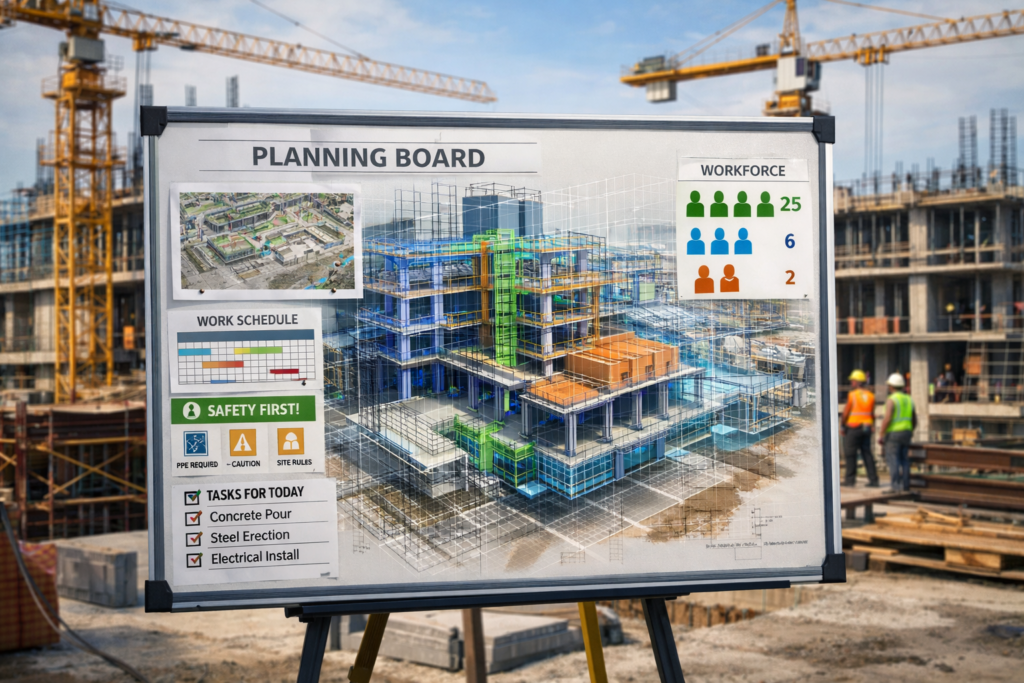
In construction, resource allocation is not just a scheduling exercise—it is a strategic management process that integrates planning, procurement, logistics, workforce management, and financial control. From mobilizing tower cranes to sequencing skilled labor trades, every decision impacts productivity rates and cost performance. Modern projects are increasingly complex, with multi-disciplinary teams, subcontractors, and parallel work packages. Without structured allocation strategies, projects quickly fall into reactive firefighting mode.
This guide explains resource allocation strategies in planning in a practical, construction-focused way. It covers fundamental concepts, proven methodologies, advanced applications, digital tools, real-world case studies, worked calculations, checklists, and common mistakes. The objective is simple: help project managers, planners, engineers, and site managers build predictable, efficient, and resilient project plans that optimize resources instead of wasting them.
Table of Contents
Why Resource Allocation Matters in Construction
Impact on Cost Control
Labor typically accounts for 30–50% of total project cost, equipment 10–20%, and materials 40–60% depending on project type [1]. Inefficient allocation directly increases:
- Overtime costs
- Idle labor hours
- Equipment standby costs
- Material wastage
Impact on Schedule Performance
Resource conflicts are one of the main causes of schedule delays. When multiple activities require the same crew, crane, or access zone, delays cascade across the schedule.
Impact on Safety
Overcrowded work zones and rushed schedules increase accident risk. Proper allocation supports safe work sequencing and site logistics.
Impact on Quality
Overloaded crews make mistakes. Balanced workloads improve workmanship, inspection compliance, and rework reduction.
Fundamental Concepts
Resource Types
- Human resources: skilled, semi-skilled, unskilled labor
- Equipment: cranes, excavators, formwork systems
- Materials: concrete, steel, MEP components
- Financial resources: cash flow, working capital
- Time: schedule buffers and float
Resource Constraints
Every project operates under constraints:
- Limited skilled labor
- Equipment availability
- Cash flow cycles
- Site access and logistics
Capacity vs Demand
Capacity planning compares available resources with activity demand:
Utilization Rate=Available CapacityActual Used Capacity×100
Utilization above 85–90% often increases risk of burnout, errors, and delays.
Practical Methodologies & Techniques
1. Resource Loading
Assigning specific resources to each schedule activity.
Steps:
- Define activity quantities
- Assign productivity rates
- Calculate resource demand
- Map demand to calendar
Worked Example: Concrete slab = 600 m² Productivity = 30 m²/day/crew
Crews required=30×5600=4 crews
2. Resource Leveling
Balancing peaks and troughs in resource demand.
Checklist:
- Identify peaks
- Shift non-critical tasks
- Use float
- Re-sequence activities
3. Resource Smoothing
Optimizing within float limits without affecting project duration.
4. Critical Resource Allocation
Prioritizing scarce resources:
- Tower cranes
- Specialized welders
- High-voltage electricians
Advanced Applications
Multi-Project Resource Planning
Portfolio-level allocation across projects.
BIM-Based Resource Planning
4D BIM links resources with schedule and model elements.
AI-Based Forecasting
Predictive analytics for labor demand and productivity.
Tools & Software
- Primavera P6
- MS Project
- Oracle Aconex
- Autodesk Construction Cloud
- Power BI dashboards
Common Mistakes & Solutions
- Over-allocation of crews → Apply leveling
- Ignoring productivity data → Use historical benchmarks
- No buffer planning → Add resource buffers
- Poor subcontractor coordination → Integrated planning
- Manual tracking only → Digital dashboards
Case Studies
Case Study 1: High-Rise Residential Project
Problem: Crane conflicts Solution: Critical resource scheduling Result: 18% schedule improvement
Case Study 2: Highway Project
Problem: Labor shortages Solution: Multi-skilling + phased deployment Result: 12% cost savings
FAQ
What is resource allocation in construction planning? Strategic distribution of labor, equipment, materials, and time.
What is resource leveling? Balancing resource demand over time.
What is the difference between loading and leveling? Loading assigns resources, leveling optimizes them.
How does BIM help? Links resources to 4D schedules.
What tools are best? Primavera, MS Project, BIM platforms.
How often should plans be updated? Weekly at minimum.
Conclusion
Resource allocation strategies in planning are not optional—they are essential for predictable, profitable, and safe construction delivery. Effective allocation transforms chaotic projects into controlled production systems. By combining structured methodologies, digital tools, real-time data, and disciplined planning processes, project teams can achieve higher productivity, lower costs, and better schedule performance.
Organizations that invest in strong allocation frameworks gain competitive advantage through faster delivery, better margins, and improved client satisfaction. The path forward is clear: plan resources as strategically as budgets and schedules.
Related Articles (Famcod)
- Critical Path Method (CPM) Guide for Construction 2026
- Dependency Types in Construction Scheduling (FS, SS, FF, SF) Explained: Complete Guide 2026
- Float Calculation Methods: Total Float vs Free Float in Construction Scheduling
- Schedule Compression Techniques in Construction: Crashing vs Fast-Tracking Explained
- Resource Allocation Strategies in Planning for Construction Projects
Recommended Resources
“Construction Planning and Scheduling” – Practical scheduling and resource planning guide. [Amazon Affiliate Link]
“Project Management for Construction” – Industry-standard reference. [Amazon Affiliate Link]
“Lean Construction Management” – Productivity-focused planning. [Amazon Affiliate Link]
Coursera: “Construction Project Management” [Coursera Affiliate Link]
Coursera: “Planning and Scheduling” [Coursera Affiliate Link]
WordPress Publishing Details
Category: Planning & Scheduling > Resource Management
Primary Focus Keyword: resource allocation strategies in planning
Secondary Keywords: construction resource planning, resource leveling, workforce planning, project scheduling, capacity planning, BIM resource management, construction productivity
Meta Title: Resource Allocation Strategies in Planning 2026
Meta Description: Practical guide to resource allocation strategies in planning for construction projects with tools, case studies, and checklists.
Featured Image: Construction site planning board with cranes, workforce icons, BIM model overlay
Reading Time: 14 minutes
About the Author