Introduction
Construction risk management emerges as the critical discipline to identify, assess, and mitigate these threats before they escalate. In 2026, with global infrastructure spending projected to hit $9 trillion, effective risk strategies prevent up to 30% of cost overruns and safety incidents.
This masterclass equips project managers, contractors, and engineers with actionable frameworks tailored to construction. Readers gain step-by-step processes, real-world case studies, and tools to implement immediately. Mastering construction risk management ensures projects finish on time, under budget, and incident-free, turning potential disasters into predictable successes.
Table of Contents
Why Risk Management Matters in Construction
Delays from poor risk handling cost the industry $1.6 trillion annually, with 70% of projects exceeding budgets by 10-20%. Safety risks compound this: construction accounts for 20% of all workplace fatalities despite comprising 5% of the workforce. In 2025, workforce shortages and supply chain volatility amplify these issues, making proactive construction risk management non-negotiable.
Effective risk management slashes downtime by 25% and boosts profitability through contingency planning. For instance, firms using structured risk processes report 15% fewer claims and disputes. Stakeholders from owners to subs benefit, as clear risk allocation fosters trust and accountability.
Fundamental Concepts of Construction Risk Management
Risk in construction refers to uncertain events that could impact project objectives like cost, schedule, quality, or safety. Risks divide into threats (negative impacts) and opportunities (positive gains). Key types include financial (budget overruns), operational (delays), safety (accidents), environmental (weather), and legal (compliance failures).
Risk appetite defines tolerance levels, while risk threshold sets action triggers. Probability (likelihood) and impact (severity) form the basis for assessment. Inherent risk exists pre-mitigation; residual risk remains post-controls.
The PMBOK risk management process outlines six steps: plan, identify, assess, respond, monitor, and control. This framework adapts to construction’s dynamic sites.
Practical Methodologies and Techniques
Risk Identification Techniques
Brainstorming workshops, checklists, and SWOT analysis uncover risks early. Use historical data from past projects and site inspections. For construction, Delphi technique gathers expert input anonymously to avoid bias.
Step-by-step risk identification:
- Assemble team (PM, engineers, subs).
- Review contracts, designs, schedules.
- Walk site for hazards like unstable soil.
- Document in risk register.
Qualitative Risk Analysis
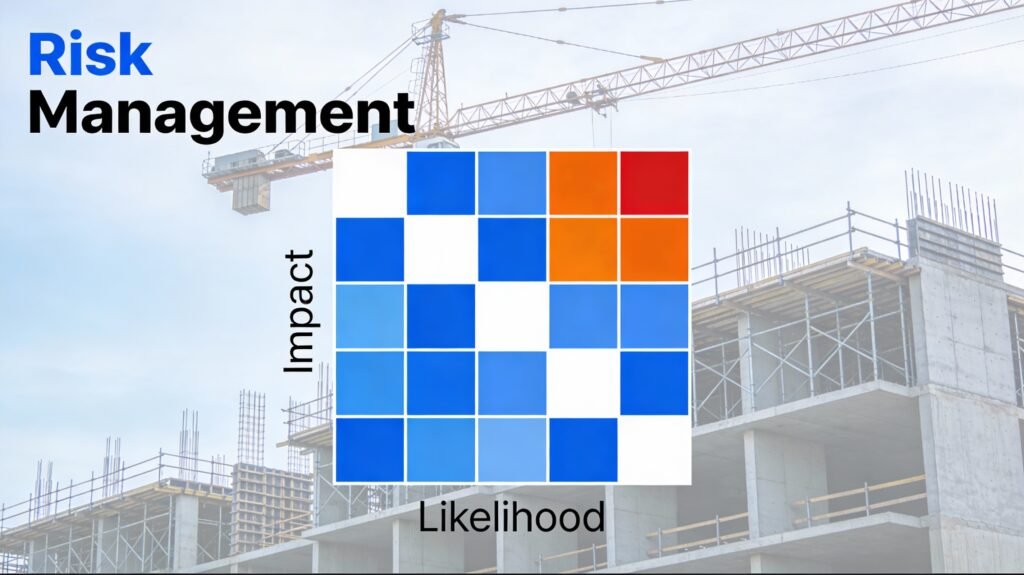
Score risks on probability (1-5) and impact (1-5) scales. Multiply for risk score: Risk Score=P×I. High scores (>15) prioritize action. Matrices visualize urgency.
| Probability | Low Impact | Medium Impact | High Impact |
|---|---|---|---|
| Low | Low | Low | Medium |
| Medium | Low | Medium | High |
| High | Medium | High | Critical |
Quantitative Risk Analysis
Apply Expected Monetary Value (EMV): EMV=P×I, where P is probability and I is cost impact. Sum for total contingency. Monte Carlo simulations model thousands of scenarios for schedule risks.
Risk Response Planning
Strategies: avoid (change plan), mitigate (reduce probability/impact), transfer (insurance), accept (monitor). Construction favors mitigation like phased scheduling.
Advanced Applications in Risk Management
Digital twins and BIM integrate real-time data for predictive risk modeling, reducing clashes by 40%. AI analytics forecast delays from weather patterns. In megaprojects, enterprise risk management (ERM) aligns site risks with corporate goals.
Agile risk management suits modular construction: iterative sprints with daily stand-ups catch issues fast. Blockchain ensures transparent supply chain tracking, mitigating material shortages.
Sensitivity analysis tests “what-if” scenarios, like steel price hikes. Advanced firms use machine learning for anomaly detection in safety data.
Tools and Software for Construction Risk Management
Top 2025 tools streamline construction risk management. Procore offers risk registers and incident tracking (4.4/5 Capterra). Field1st provides AI dashboards for real-time hazards.
SafetyCulture excels in checklists and audits, with offline mobile access. Mastt handles portfolios with custom scoring. Primavera P6 computes exposure via midpoints: Exposure=Pmid×Cmid.
| Tool | Key Feature | Best For | Rating |
|---|---|---|---|
| Procore | Risk forms, integrations | General contractors | 4.4 |
| Field1st | AI predictions | Safety-focused | 4.7 |
| Mastt | Portfolio risk | Owners/PMs | 4.3 |
Common Mistakes and Solutions
- Ignoring low-probability risks: Solution: Use checklists covering tails like pandemics.
- Static risk registers: Update weekly; automate with software.
- Poor stakeholder buy-in: Train teams; assign owners.
- Overlooking opportunities: Balance threats with upsides like early finishes.
- Inadequate quantification: Always compute EMV for budgets.
Case Study 1: Berlin Brandenburg Airport Failure
Berlin Brandenburg Airport (BER) ballooned from €2.8B to €7B with 9-year delays due to poor risk management. Risks like wiring flaws and IT failures went unidentified; no contingency for scope creep. Poor planning caused 50% overruns.
Lessons: Implement BIM early, conduct phased audits. Proper construction risk management could have saved €4B.
Case Study 2: Fehmarnbelt Tunnel Success
The Fehmarnbelt immersed tunnel used dynamic risk registers and Predict! software, opting for tunnel over bridge via modeling. Result: Controlled costs, zero LTIs. Risk index prioritized weather/equipment threats.
Worked Examples with Calculations
Example 1: EMV for Delay Risk
A $10M project faces 30% chance of 2-month weather delay costing $500K.
EMV=0.3×500,000=150,000
Reserve $150K.
Example 2: Risk Exposure in Primavera
Cost range $45K-$90K (mid $67.5K), prob 50-70% (mid 60%).
Exposure=0.6×67,500=40,500 .
Risk Register Template and Checklists
Sample Risk Register (Excel-like):
| Risk ID | Description | P | I | Score | Response | Owner |
|---|---|---|---|---|---|---|
| 001 | Supply delay | 4 | 3 | 12 | Mitigate | PM |
| 002 | Safety incident | 2 | 5 | 10 | Transfer | Safety Mgr |
Pre-Construction Checklist:
Daily Site Checklist:
FAQ
1. What is construction risk management?
Systematic process to identify, analyze, and respond to threats/opportunities.
2. How to calculate contingency reserves?
Sum EMVs of top risks; add 10-20% buffer.
3. Best software for small contractors?
SafetyCulture for mobile checklists.
4. Common safety risks?
Falls, slips, struck-by; mitigate with PPE, rails.
5. Difference between qualitative vs quantitative?
Qualitative: Scoring; quantitative: Numeric models like Monte Carlo.
6. How often update risk register?
Weekly or post-change.
7. Role of AI in 2025?
Predictive analytics for delays.
8. Insurance vs self-insure?
Transfer high-impact risks; retain low ones.
Conclusion
Construction risk management transforms uncertainty into control, preventing the 98% of projects facing delays or overruns. Key takeaways: Identify early with checklists, quantify via EMV EMV=P×I, respond decisively, and monitor via software. Case studies like BER highlight inaction costs, while Fehmarnbelt shows proactive wins.
Implement a risk register today, train your team, and integrate tools like Procore. Your next project delivers on time, safe, and profitable. Download Famcod’s free templates and start mitigating risks now—schedule a consultation at Famcod.com.
Related Articles
- Critical Path Method (CPM) Guide for Construction 2026
- Dependency Types in Construction Scheduling (FS, SS, FF, SF) Explained: Complete Guide 2026
- Float Calculation Methods: Total Float vs Free Float in Construction Scheduling
- Schedule Compression Techniques in Construction: Crashing vs Fast-Tracking Explained
- Resource Allocation Strategies in Planning for Construction Projects
Recommended Resources


About the Author