Introduction
Baseline schedule development and creation is one of the most critical foundations of successful construction project management. Every project—whether a residential building, commercial tower, industrial plant, or infrastructure corridor—depends on a realistic, structured, and measurable baseline schedule. Without it, project teams operate in reactive mode, managing crises instead of controlling outcomes.

A baseline schedule is not just a timeline—it is a control framework. It defines how work is sequenced, how resources are allocated, how costs are distributed, and how performance is measured. When delays occur, claims arise, or scope changes happen, the baseline becomes the reference document for analysis, dispute resolution and decision-making.
In real-world construction, poor baseline schedules cause cascading failures: subcontractor conflicts, idle resources, material shortages, productivity losses, and contractual disputes. Studies show that poorly planned schedules contribute to over 35% of project delays in large construction projects . A strong baseline schedule, on the other hand, improves coordination, reduces uncertainty, and enables proactive control.
This guide provides a complete, practical framework for baseline schedule development and creation—from concepts and methodologies to tools, formulas, real-world case studies, and implementation checklists. It is designed for engineers, planners, project managers, site managers, and contractors who want schedules that are not only compliant but operationally effective.
Table of Contents
Why Baseline Scheduling Matters in Construction
Contractual Control
The baseline schedule is a contractual reference. It defines:
- Milestone dates
- Liquidated damages timelines
- Extension of time (EOT) analysis
- Delay responsibility allocation
Financial Control
Schedule delays directly impact costs:
- Equipment idle time
- Labor inefficiencies
- Material price escalation
- Overhead extension
A 30-day delay on a mid-size commercial project can increase costs by 5–8% due to overheads and inefficiencies [2].
Risk Management
Baseline schedules enable early identification of:
- Critical activities
- Resource bottlenecks
- Procurement risks
- Interface risks between trades
Performance Measurement
Baseline vs actual enables:
- Schedule variance (SV)
- Schedule performance index (SPI)
- Forecasting completion dates
Fundamental Concepts of Baseline Scheduling
Work Breakdown Structure (WBS)
A WBS decomposes the project into manageable components.
Example:
- Level 1: Project
- Level 2: Substructure, Superstructure, Finishes, MEP
- Level 3: Footings, Columns, Slabs, Walls
Activity Definition
Each activity must have:
- Clear scope
- Measurable output
- Defined start and finish
- Responsible party
Logical Relationships
Common relationships:
- Finish-to-Start (FS)
- Start-to-Start (SS)
- Finish-to-Finish (FF)
- Start-to-Finish (SF)
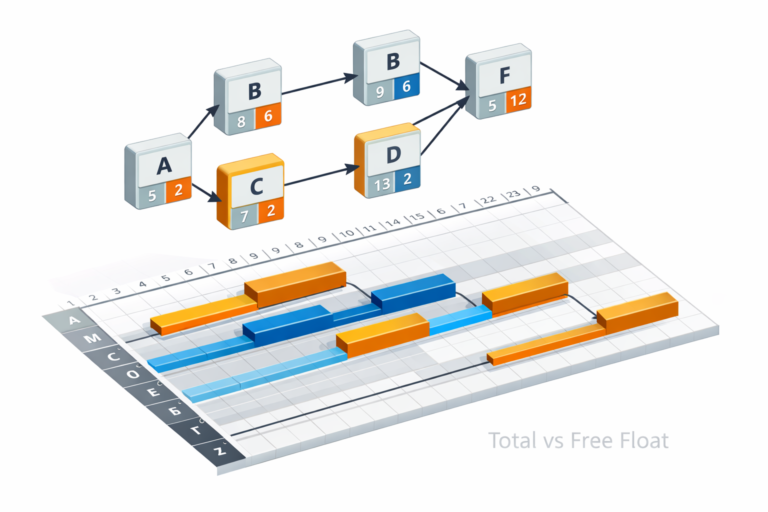
Critical Path Method (CPM)
The critical path is the longest-duration path through the network.
Formula (Float Calculation):
Total Float=LS−ES=LF−EF
Where:
- ES = Early Start
- EF = Early Finish
- LS = Late Start
- LF = Late Finish
Practical Methodologies for Baseline Schedule Creation
Step-by-Step Baseline Development Process
- Define scope and WBS
- Identify activities
- Sequence activities
- Estimate durations
- Assign resources
- Develop network logic
- Run CPM analysis
- Optimize resources
- Validate milestones
- Freeze baseline
Duration Estimation Techniques
Productivity-Based Estimation
Duration=ProductivityQuantity
Worked Example: Concrete slab: 1,200 m²
Productivity: 120 m²/day
Duration = 1200 / 120 = 10 days
Resource Loading
Align labor, equipment, and materials with activities to avoid peaks.
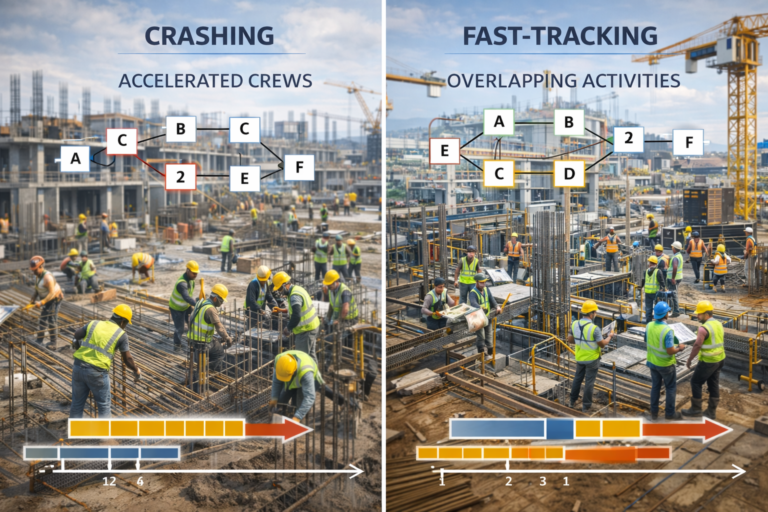
Schedule Compression Techniques
- Crashing (adding resources)
- Fast-tracking (parallel work)
Advanced Applications in Complex Projects
Multi-Project Integration
Used in mega projects and EPC contracts.
BIM + Schedule Integration (4D Scheduling)
Combines model + time for visual planning.
Risk-Based Scheduling
Monte Carlo simulations for schedule risk.
Tools & Software for Baseline Scheduling
| Tool | Use Case | Strength |
|---|---|---|
| Primavera P6 | Mega projects | Advanced CPM |
| MS Project | Small-mid projects | Easy interface |
| Asta Powerproject | UK projects | Construction logic |
| Synchro | 4D BIM | Visual planning |
Common Mistakes and Practical Solutions
- Unrealistic durations → Use productivity norms
- Poor logic links → Enforce CPM validation
- No resource leveling → Apply smoothing
- Ignoring procurement → Integrate lead times
- Static schedules → Update weekly
Case Study 1: Residential High-Rise Project
Project: 20-storey residential tower
Problem: 4-month delay risk
Solution: Re-baselined with CPM + resource leveling
Result: Delay reduced to 6 weeks
Case Study 2: Industrial Plant Construction
Project: Manufacturing plant
Baseline Duration: 14 months
Optimization: Fast-tracking structure + services
Outcome: 9% time savings
Case Study 3: Infrastructure Highway Project
Project: 18 km highway
Technique: Zone-based baseline scheduling
Result: Improved subcontractor coordination
Frequently Asked Questions (FAQ)
- What is a baseline schedule?
- Why is CPM important?
- How often should baselines be updated?
- What tools are best for contractors?
- How to manage changes?
- What is float in scheduling?
Conclusion and Key Takeaways
Baseline schedule development and creation is the backbone of construction project success. A strong baseline schedule enables control, accountability, forecasting, and performance measurement. Projects with structured baseline schedules consistently outperform poorly planned projects in cost, time, and quality outcomes.
By applying structured methodologies, realistic productivity data, CPM logic, resource optimization, and digital tools, project teams can transform schedules from static documents into dynamic project control systems. The baseline schedule is not paperwork—it is a strategic asset.
Free Resources
Free baseline templates, WBS structures, CPM logic charts, and productivity calculation sheets are available through Famcod’s project management resource hub.
Related Articles
- Critical Path Method (CPM) Guide for Construction 2026
- Dependency Types in Construction Scheduling (FS, SS, FF, SF) Explained: Complete Guide 2026
- Float Calculation Methods: Total Float vs Free Float in Construction Scheduling
- Schedule Compression Techniques in Construction: Crashing vs Fast-Tracking Explained
- Resource Allocation Strategies in Planning for Construction Projects
Recommended Resources
“Construction Planning and Scheduling” – Brian Cooke – [Amazon Affiliate Link]
“Project Management for Construction” – Chris Hendrickson – [Amazon Affiliate Link]
“CPM in Construction Management” – [Amazon Affiliate Link]
Coursera: “Construction Scheduling” – [Coursera Affiliate Link]
Coursera: “Project Management Principles” – [Coursera Affiliate Link]
About the Author