Introduction
Accurate cost estimation is one of the most critical success factors in construction project management. Projects fail not only because of poor execution but because of unrealistic budgets, inaccurate forecasts, and unreliable planning assumptions. Among the modern estimation methods, parametric estimation techniques stand out as one of the most scalable, data-driven, and reliable approaches for forecasting project costs, durations, and resource requirements.
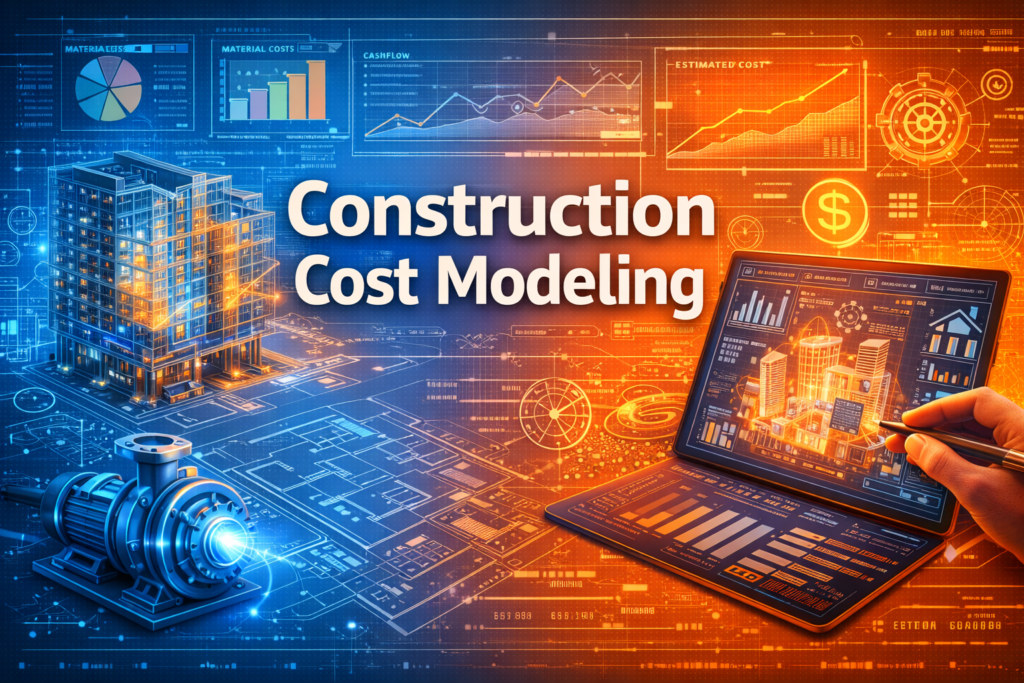
Parametric estimation techniques use statistical relationships between historical project data and key project variables (parameters) such as area, volume, number of floors, road length, capacity, or production rates. Instead of guessing or relying only on expert judgment, parametric models convert real project data into predictive formulas and cost models.
For construction professionals, this approach offers three major advantages:
- Speed → Faster early-stage estimates
- Consistency → Standardized forecasting logic
- Scalability → Easy adaptation across projects of different sizes
As project complexity increases and margins tighten, construction firms can no longer depend solely on traditional analogous estimation or rough approximations. Parametric estimation techniques enable data-driven decision-making, improve investor confidence, and significantly reduce cost overruns.
This guide explains parametric estimation techniques from fundamentals to advanced applications, with formulas, step-by-step processes, real-world construction examples, tools, case studies, and implementation checklists—specifically tailored for construction project managers, engineers, estimators, and consultants.
Table of Contents
Why Parametric Estimation Matters in Construction
Cost Overruns Are Still a Global Problem
Industry studies consistently show that 70–90% of large construction projects experience cost overruns [1]. The primary causes include:
- Poor early-stage estimation
- Incomplete scope definition
- Inaccurate assumptions
- Lack of historical data utilization
- Manual estimation errors
Parametric Estimation Solves Structural Problems
Parametric estimation addresses systemic weaknesses in traditional estimating by:
- Replacing subjective judgment with statistical models
- Enabling repeatable estimation processes
- Supporting early feasibility analysis
- Improving financial planning accuracy
Strategic Benefits for Construction Firms
| Area | Impact |
|---|---|
| Financial Planning | Accurate CAPEX forecasting |
| Bidding Strategy | Competitive but realistic pricing |
| Risk Management | Predictable cost variability |
| Scheduling | Reliable duration estimation |
| Resource Planning | Better labor/material allocation |
| Investor Confidence | Data-backed feasibility studies |
Business Impact Example
A mid-sized EPC contractor using parametric models for infrastructure projects reduced average bid variance by 18% and improved project profit margins by 12% within 18 months .
Fundamental Concepts of Parametric Estimation
What Is Parametric Estimation?
Parametric estimation is a forecasting technique that uses mathematical relationships between project variables and historical performance data to predict cost, duration, and resources.
Key Parameters in Construction
Common construction parameters include:
- Built-up area (m² / ft²)
- Number of floors
- Road length (km)
- Bridge span length
- Concrete volume (m³)
- Steel tonnage
- Pipe length
- Capacity (MW, MLD, tons/day)
Core Components
1. Historical Data
Reliable past project data forms the foundation.
2. Cost Drivers
Variables that directly influence cost:
- Area
- Volume
- Capacity
- Complexity index
- Location factor
3. Statistical Relationships
Regression models, ratios, and scaling functions.
4. Calibration
Model adjustment using real project outcomes.
Core Parametric Estimation Models
1. Linear Parametric Models
Simple proportional relationships:Cost=a×Parameter+b
Example:
Cost = 1200 × Area (m²) + 50,000
2. Power Law Models (Scaling Models)
Cost=a×(Size)b
Used for large infrastructure projects where economies of scale apply.
3. Multivariable Parametric Models
Cost=a+b1x1+b2x2+b3x3
Example variables:
- Area
- Floors
- Structural complexity
- Location index
4. Unit Rate Models
Total Cost=Unit Cost×Quantity
Example:
₹1,800/m² × 10,000 m² = ₹18 Cr
Data Requirements and Data Quality Management
Data Sources
- Past project BOQs
- ERP systems
- BIM models
- Cost databases
- Government schedules of rates
- Industry benchmarks
Data Quality Checklist
- Accuracy
- Completeness
- Consistency
- Relevance
- Time relevance (inflation-adjusted)
Checklist: Data Preparation
- Normalize costs for inflation
- Adjust for location factors
- Standardize units
- Remove outliers
- Validate assumptions
Mathematical Foundations and Formulas
Core Parametric Formula
Estimated Cost=Base Cost×Scaling Factor×Adjustment Factors
Where:
- Base Cost = historical benchmark
- Scaling Factor = size relationship
- Adjustment Factors = location, inflation, complexity, risk
Worked Example (Calculation)
Given:
- Historical building cost = ₹1,500/m²
- New project area = 12,000 m²
- Location factor = 1.08
- Inflation factor = 1.06
Estimated Cost=1500×12,000×1.08×1.06 =₹206,064,000≈₹20.6Cr
Practical Methodologies and Techniques
Technique 1: Area-Based Parametric Estimation
Steps:
- Identify building type
- Select benchmark cost/m²
- Apply area
- Adjust for:
- Location
- Quality grade
- Complexity
- Market inflation
Checklist:
- Validate unit cost source
- Apply inflation index
- Adjust design complexity
- Add contingency (5–15%)
Technique 2: Capacity-Based Estimation
Used for:
- Water treatment plants
- Power plants
- Industrial facilities
Cost=Cost/Unit×Capacity
Example:
₹3 Cr per MLD × 20 MLD = ₹60 Cr
Technique 3: Multivariable Regression Models
Process:
- Collect dataset
- Identify key drivers
- Build regression model
- Validate accuracy
- Calibrate continuously
Technique 4: Hybrid Parametric Models
Combination of:
- Unit rates
- Scaling laws
- Historical benchmarks
- Risk multipliers
Advanced Applications in Modern Construction
BIM + Parametric Estimation
- Auto-quantity extraction
- Dynamic cost modeling
- Real-time cost updates
AI-Based Parametric Models
- Machine learning regression
- Pattern recognition
- Predictive analytics
Risk-Adjusted Parametric Models
- Monte Carlo simulations
- Probabilistic cost ranges
- Scenario modeling
Digital Twin Integration
- Live data feeds
- Predictive cost performance
- Operational forecasting
Tools & Software for Parametric Estimation
Industry Tools
| Tool | Application |
|---|---|
| CostX | BIM-based estimation |
| PlanSwift | Parametric takeoffs |
| Primavera | Schedule integration |
| RSMeans | Cost databases |
| Power BI | Cost analytics |
| Excel + Python | Custom models |
Checklist: Tool Selection
- Data integration capability
- BIM compatibility
- Scalability
- Reporting features
- Custom modeling support
Common Mistakes and Solutions
Mistake 1: Poor Data Quality
Solution: Data validation protocols
Mistake 2: Overgeneralization
Solution: Project-specific calibration
Mistake 3: Ignoring Local Factors
Solution: Location adjustment indexes
Mistake 4: No Risk Contingency
Solution: Risk-based buffers
Mistake 5: Static Models
Solution: Continuous model updating
Case Study 1: Residential Housing Project
Project: 500-unit housing complex
Area: 45,000 m²
Benchmark Cost: ₹1,400/m²
Adjustments:
- Location factor = 1.05
- Quality factor = 1.10
- Inflation = 1.07
Cost=1400×45,000×1.05×1.10×1.07 =₹78.8Cr(approx)
Outcome:
Final project cost deviation: +3.2% (high accuracy)
Case Study 2: Highway Infrastructure Project
Length: 18 km
Unit Cost Benchmark: ₹7.5 Cr/km
Terrain factor: 1.15
Inflation: 1.06Cost=7.5×18×1.15×1.06 =₹164.6Cr
Deviation: 4.7%
Case Study 3: Commercial High-Rise Building
Floors: 22
Area: 38,000 m²
Model: Multivariable parametric
Accuracy: 96.1% estimate accuracy
Schedule variance: -5.3%
Frequently Asked Questions (FAQ)
1. What is parametric estimation in construction?
A data-driven estimation method using mathematical relationships between project variables and historical data.
2. How accurate is parametric estimation?
When calibrated properly, accuracy typically ranges between 90–97%.
3. Is parametric better than detailed BOQ estimation?
It is better for early-stage planning; BOQs are better for execution-phase costing.
4. What data is required?
Historical cost data, project parameters, adjustment factors.
5. Can parametric estimation be automated?
Yes, using BIM, AI models, and estimation software.
6. Is it suitable for small projects?
Yes, especially for feasibility and budgeting.
7. How often should models be updated?
After every completed project cycle.
Conclusion and Key Takeaways
Parametric estimation techniques represent a fundamental shift in how construction projects are planned, budgeted, and managed. Instead of relying on assumptions and guesswork, this method introduces data-driven predictability into one of the most uncertain aspects of project management—cost forecasting.
By using statistical relationships, standardized parameters, and calibrated models, construction professionals can:
- Improve estimation accuracy
- Reduce financial risk
- Enhance bidding competitiveness
- Strengthen investor confidence
- Optimize resource allocation
- Improve project success rates
Parametric estimation is not a replacement for detailed costing—it is a strategic planning tool that strengthens decision-making at early stages where most project risks originate.
For modern construction organizations, adopting parametric estimation techniques is no longer optional—it is a competitive necessity.
Free Resources Available
- Open-source construction cost databases
- Government Schedule of Rates portals
- BIM object libraries
- Excel parametric model templates
- Online regression modeling tools
Related Articles (Famcod)
- Parametric Estimation Techniques in Construction Project Management
- Project Management Body of Knowledge (PMBOK) for Construction – Complete 2026 Guide
- Earned Value Management in Construction (EVM) – 2026 Guide
- Construction Cost Budgeting Guide 2026
Recommended Resources
📚 Amazon Books
- “Construction Cost Estimating” – Practical estimating frameworks
👉 Amazon Affiliate Link - “Project Estimation and Cost Management” – Data-driven project costing
👉 Amazon Affiliate Link - “Construction Planning, Programming and Control” – Integrated planning models
👉 Amazon Affiliate Link - “Engineering Economics and Cost Analysis” – Financial modeling in engineering
👉 Amazon Affiliate Link
About the Author