Introduction
Signals and Systems is one of those rare engineering textbooks that has achieved near-classic status across electrical engineering, electronics, computer science, and applied mathematics programs worldwide. Written by Alan V. Oppenheim (with contributions from Alan S. Willsky and S. Hamid Nawab in later editions), this book is widely regarded as a gold standard for understanding how signals behave and how systems process them.
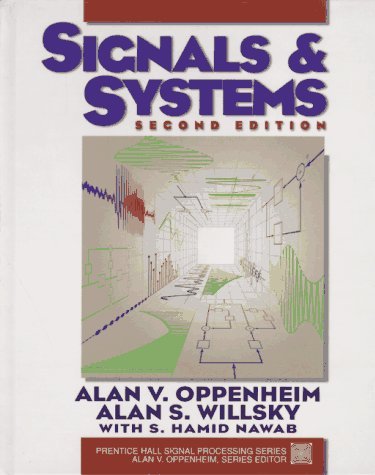
Rather than treating the subject as a collection of formulas, the book focuses on conceptual clarity, helping readers build intuition around continuous-time and discrete-time signals. If you’re a student, educator, or practicing engineer struggling to truly understand signals and systems (not just pass exams), this book deserves your attention. Keep reading for a clear summary, pros and cons, and buying details.
Table of Contents
About the Book
Signals and Systems falls under the engineering textbook / academic reference genre, specifically targeting signal processing fundamentals. It is commonly used in undergraduate and graduate courses in:
- Electrical & Electronics Engineering
- Computer Engineering
- Communications Engineering
- Data Science & Applied Mathematics
The book covers essential topics such as linear time-invariant (LTI) systems, convolution, Fourier series, Fourier transforms, Laplace transforms, and sampling. What sets it apart is its concept-first approach, supported by mathematical rigor where necessary.
Published by Pearson, the book has gone through multiple editions, reflecting its long-standing relevance in academia. It’s best suited for readers with a basic background in calculus and linear algebra.
About the Author
Alan V. Oppenheim is a legendary name in signal processing education. He is a professor at MIT and has played a pivotal role in shaping how signals and systems are taught globally. His teaching style emphasizes intuition and physical interpretation, not rote memorization.
Apart from Signals and Systems, Oppenheim has co-authored several influential works and research papers in digital signal processing. His credibility is further reinforced by decades of teaching at MIT and the widespread adoption of his textbooks in top universities.
Summary / Key Takeaways
Here are the core ideas you’ll gain from reading Signals and Systems:
- A deep understanding of signals (continuous-time and discrete-time) and how they are represented
- Clear explanations of LTI systems and why they matter in real-world applications
- Practical intuition behind convolution, rather than just mathematical procedures
- Strong foundations in Fourier analysis for frequency-domain thinking
- Insight into sampling and reconstruction, critical for digital systems
The book avoids unnecessary distractions and keeps the focus on building a solid mental framework.
What Readers Liked
Readers and students consistently praise this book for several reasons:
- Exceptional clarity in explaining complex mathematical concepts
- Emphasis on intuition and physical meaning, not just equations
- Well-structured progression from basic ideas to advanced topics
- Excellent diagrams and examples that reinforce learning
- Long-term value as both a course textbook and reference guide
Many readers note that once the concepts “click,” this book becomes an invaluable companion throughout their engineering career.
What Could Be Better
While highly respected, the book isn’t without minor drawbacks:
- The writing style is academic, which may feel dense for absolute beginners
- Fewer step-by-step solved numerical problems compared to exam-oriented guides
- Requires strong mathematical maturity, especially in later chapters
That said, these limitations are often expected in a concept-heavy foundational text.
Why You Should Read It
If you want more than surface-level knowledge, Signals and Systems is worth your time. This book helps you think like an engineer, enabling you to analyze, design, and understand systems rather than memorizing shortcuts.
It’s especially valuable if you’re interested in areas like:
- Signal processing
- Communications systems
- Control systems
- Machine learning foundations
- Embedded and digital systems
Buy This Book
Ready to add this classic to your library?

About the Author