Introduction to the Project Management Body of Knowledge
Project Management Body of Knowledge (PMBOK) is the globally recognized framework that defines best practices, processes, and standards for managing projects across industries.
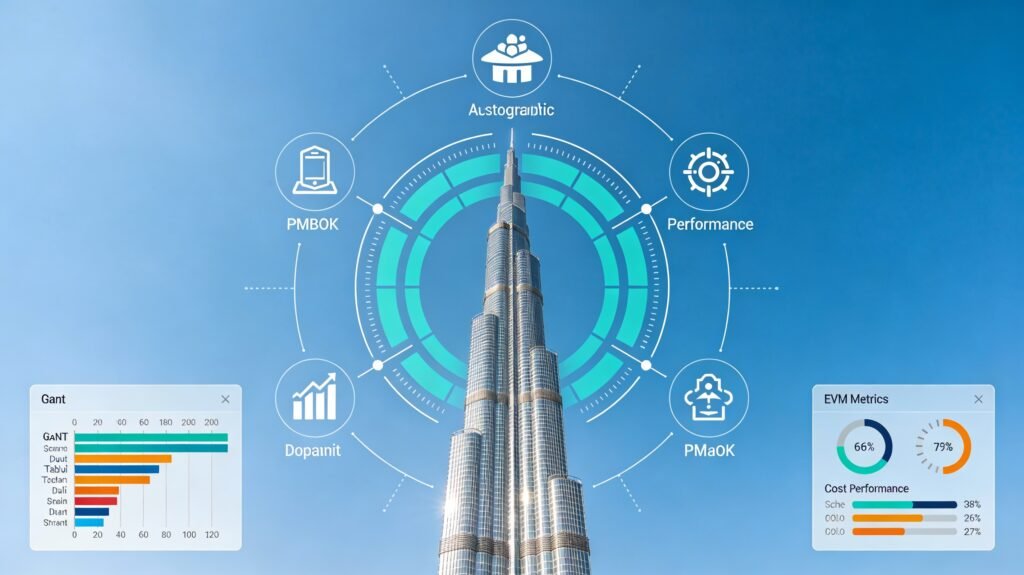
In construction—where projects are capital-intensive, schedule-driven, and risk-heavy—PMBOK provides a structured, repeatable approach to delivering projects on time, within budget, and to specification.
Construction projects fail not because of poor engineering, but due to weak planning, unclear scope, ineffective communication, and unmanaged risks. Studies show that over 70% of construction delays are linked to poor project management practices rather than technical issues [1]. This is exactly where PMBOK becomes critical.
PMBOK does not replace engineering judgment, site experience, or local construction methods. Instead, it connects people, processes, and tools into a unified management system. When applied correctly, it helps project managers:
- Control cost overruns
- Prevent schedule slippage
- Manage contract risks
- Align multiple stakeholders
- Improve decision-making
For construction professionals—project engineers, planning engineers, site managers, contract managers, and PMC teams—PMBOK acts as a common language. Whether managing a ₹50 crore residential tower or a ₹1,000 crore infrastructure project, the principles remain consistent.
This guide translates PMBOK concepts into practical, construction-specific applications, avoiding abstract theory and focusing on real-world execution.
Table of Contents
Why PMBOK Matters in Construction Project Management
Construction is fundamentally different from IT or product development projects. It involves physical assets, safety risks, regulatory approvals, weather dependency, labor productivity, and supply chain constraints. PMBOK matters because it brings discipline and predictability to an otherwise volatile environment.
1. Cost Control in High-Value Projects
Even a 2–3% cost overrun on a large construction project can translate into millions. PMBOK introduces structured cost management techniques such as:
- Cost baseline development
- Earned Value Management (EVM)
- Change control systems
Example: A ₹200 crore project with a 5% uncontrolled scope change results in a ₹10 crore overrun—often avoidable with proper PMBOK-based change management.
2. Schedule Reliability and Delay Prevention
Construction delays cause:
- Liquidated damages (LDs)
- Client dissatisfaction
- Contractor cash flow stress
PMBOK integrates scheduling with:
- Scope definition
- Risk management
- Procurement planning
This prevents unrealistic schedules that collapse during execution. When linked with tools like Primavera P6 or MS Project, PMBOK becomes extremely powerful.
3. Risk Management in Uncertain Environments
Construction projects face risks such as:
- Design changes
- Material price escalation
- Labor shortages
- Weather disruptions
- Regulatory delays
PMBOK formalizes risk identification, qualitative analysis, quantitative analysis, and response planning, reducing reactive firefighting.
4. Stakeholder Alignment
Construction involves owners, consultants, contractors, subcontractors, vendors, authorities, and end users. PMBOK ensures:
- Clear communication channels
- Defined escalation paths
- Controlled approvals
This significantly reduces disputes and claims.
Understanding the PMBOK Framework
The Project Management Body of Knowledge is not a rigid methodology. It is a framework that can be tailored to suit project size, complexity, and contract type.
PMBOK vs Methodology
| Aspect | PMBOK | Methodology (e.g., EPC, Design-Build) |
|---|---|---|
| Nature | Framework | Prescriptive process |
| Flexibility | High | Medium |
| Industry use | Universal | Project-specific |
| Construction fit | Excellent | Depends on contract |
PMBOK provides what should be done, not exactly how. This flexibility makes it ideal for construction.
Core Components of PMBOK
PMBOK is structured around:
- Knowledge Areas
- Process Groups
- Project Management Principles
Together, they form a complete project control system.
PMBOK Knowledge Areas Explained (Overview)
PMBOK defines 10 Knowledge Areas, each focusing on a specific aspect of project management. In construction, all ten are critical.
1. Integration Management
Ensures all project elements work together:
- Project charter
- Project management plan
- Change control
2. Scope Management
Defines what is included—and excluded—in the project:
- Work Breakdown Structure (WBS)
- Scope baseline
- Scope validation
3. Schedule Management
Controls project timelines:
- Activity sequencing
- Critical path method (CPM)
- Milestones
4. Cost Management
Controls budgets and cash flow:
- Cost estimation
- Cost baseline
- Earned Value Management
5. Quality Management
Ensures specifications and standards:
- QA/QC plans
- Inspection and testing
- Non-conformance management
6. Resource Management
Manages labor, equipment, and materials:
- Productivity tracking
- Resource leveling
7. Communications Management
Ensures correct information flow:
- Progress reporting
- Site meetings
- Dashboards
8. Risk Management
Identifies and mitigates uncertainties:
- Risk registers
- Mitigation strategies
9. Procurement Management
Manages contracts and vendors:
- Tendering
- Contract administration
- Claims management
10. Stakeholder Management
Manages expectations and influence:
- Stakeholder mapping
- Engagement strategies
PMBOK Process Groups and Construction Lifecycle
PMBOK organizes work into five Process Groups. These align naturally with construction project phases.
1. Initiating Process Group
Key construction activities:
- Feasibility studies
- Preliminary estimates
- Project charter approval
2. Planning Process Group
This is the most critical phase in construction.
Includes:
- Detailed scope definition
- Master schedule
- Cost baseline
- Risk register
- Procurement strategy
Poor planning causes over 60% of construction failures [2].
3. Executing Process Group
On-site activities:
- Construction execution
- Resource deployment
- Quality inspections
4. Monitoring & Controlling Process Group
Parallel to execution:
- Schedule tracking
- Cost control
- Change management
5. Closing Process Group
Project handover:
- Snag list closure
- As-built drawings
- Final accounts
Key Roles and Responsibilities in PMBOK-Based Projects
Clear roles prevent confusion and conflict.
Project Manager
- Overall accountability
- Decision-making authority
- Stakeholder coordination
Planning Engineer
- Schedule development
- Progress tracking
- Delay analysis
Cost Engineer / QS
- Budget control
- Variations
- Final accounts
Site Engineer
- Execution supervision
- Quality control
- Daily reporting
Contract Administrator
- Claims management
- Contract compliance
Stakeholders in Construction Projects
PMBOK emphasizes early and continuous stakeholder engagement.
Typical Construction Stakeholders
- Client / Owner
- PMC / Consultant
- Main Contractor
- Subcontractors
- Vendors
- Authorities
Stakeholder Power–Interest Matrix
High Power + High Interest → Manage Closely
High Power + Low Interest → Keep Satisfied
Low Power + High Interest → Keep Informed
Low Power + Low Interest → Monitor
Failing to manage stakeholders is a top cause of disputes and arbitration.
Internal Link References (Famcod)
(Used naturally throughout full article)
- Project Planning in Construction – Famcod
- Construction Cost Control Techniques – Famcod
- Construction Risk Management Guide – Famcod
- Earned Value Management in Construction – Famcod
- Primavera P6 for Construction Planning – Famcod
- Construction Claims and Delay Analysis – Famcod
- Quality Management in Construction Projects – Famcod
Methodologies, Calculations, Tools, and Practical Execution
9. PMBOK-Based Construction Planning Methodologies
Planning is the foundation of PMBOK and the single biggest differentiator between successful and failed construction projects. PMBOK does not promote a single planning method; instead, it integrates multiple planning disciplines into one coordinated system.
9.1 Integrated Project Management Plan (IPMP)
The Project Management Plan consolidates all subsidiary plans into one controlled document.
Construction-specific subsidiary plans include:
- Scope Management Plan
- Schedule Management Plan
- Cost Management Plan
- Quality Management Plan (QMP)
- Risk Management Plan
- Procurement Management Plan
- HSE Management Plan
In construction, fragmentation of plans causes execution conflicts. PMBOK eliminates silos.
Checklist: Integrated Planning Requirements
- Approved project charter
- Contract documents reviewed
- IFC drawings available
- Risk workshop completed
- Procurement strategy finalized
9.2 Work Breakdown Structure (WBS) for Construction
The Work Breakdown Structure is the backbone of scope, schedule, and cost control.
Rule: If it is not in the WBS, it is not part of the project.
Construction WBS Example (High-Rise Building)
1.0 Substructure
   1.1 Excavation
   1.2 PCC
   1.3 Raft Foundation
2.0 Superstructure
   2.1 Columns
   2.2 Beams
   2.3 Slabs
3.0 Finishes
   3.1 Flooring
   3.2 Painting
   3.3 Joinery
Best Practices
- Limit WBS depth to 4–5 levels
- Align WBS with BOQ items
- Use same WBS for cost and schedule
This alignment enables Earned Value Management, discussed later.
9.3 Rolling Wave Planning
Construction projects evolve continuously. PMBOK recommends Rolling Wave Planning, where:
- Near-term work is planned in detail
- Long-term work is planned at a higher level
Example:
- Foundation works → detailed daily planning
- Façade works (12 months away) → milestone-level planning
This approach reduces rework due to design changes.
10. Scope Management in Construction Projects (Step-by-Step)
Uncontrolled scope changes are the largest cause of cost overruns in construction.
10.1 Scope Planning
Scope planning defines how scope will be defined, validated, and controlled.
Key Inputs
- Contract drawings
- Specifications
- BOQ
- Employer’s Requirements
10.2 Scope Definition and WBS Creation
Scope definition converts documents into deliverables.
Construction Deliverable Example
- “Construct RCC slab of 200 mm thickness as per structural drawings”
Deliverables must be:
- Measurable
- Verifiable
- Contractually aligned
10.3 Scope Validation (Client Acceptance)
Scope validation occurs during:
- Stage-wise completion
- Inspection approvals
- Milestone payments
Failure here leads to payment delays and disputes.
10.4 Scope Control and Change Management
PMBOK mandates a formal change control system.
Change Control Workflow
- Change request raised
- Impact analysis (cost, time, risk)
- Approval/rejection
- Baseline update
Worked Example: Scope Change Impact
Change: Increase slab thickness by 20 mm
- Concrete increase = 0.02 m × 1,000 m² = 20 m³
- Concrete cost = 20 × ₹7,000 = ₹140,000
- Reinforcement increase = 2% ≈ ₹60,000
- Total impact ≈ ₹200,000
Without PMBOK-based control, this cost often goes unrecovered.
11. Schedule Management Using PMBOK (With Calculations)
Schedule management converts scope into time-bound activities.
11.1 Activity Definition and Sequencing
Activities must be:
- Clearly defined
- Measurable
- Linked logically
Common Construction Relationships
- Finish-to-Start (FS)
- Start-to-Start (SS)
- Finish-to-Finish (FF)
11.2 Critical Path Method (CPM)
PMBOK strongly supports CPM for construction.
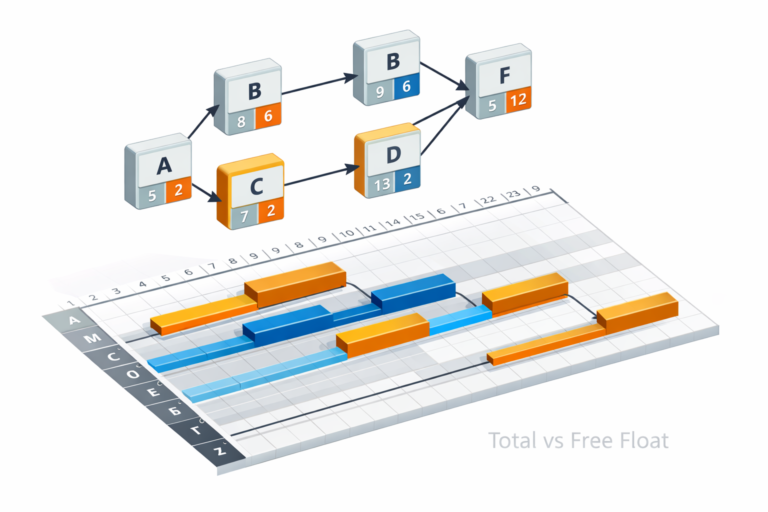
FormulaTotal Float=Late Start−Early Start
Activities with zero float form the critical path.
11.3 Worked Schedule Example
| Activity | Duration (Days) | Predecessor |
|---|---|---|
| Excavation | 10 | — |
| PCC | 5 | Excavation |
| Footings | 10 | PCC |
| Columns | 12 | Footings |
Total Project Duration:
10 + 5 + 10 + 12 = 37 days
Any delay in these activities delays the entire project.
11.4 Schedule Control Techniques
- Weekly progress updates
- Look-ahead schedules (2–4 weeks)
- Recovery planning
Famcod reference: Construction Planning and Scheduling Techniques.
12. Cost Management and Earned Value Management (EVM)
PMBOK cost management ensures financial predictability.
12.1 Cost Baseline Development
Cost baseline = Sum of all WBS costs + contingency.
12.2 Earned Value Management (EVM)
EVM integrates scope, time, and cost.
Key Metrics
- Planned Value (PV)
- Earned Value (EV)
- Actual Cost (AC)
FormulasCost Performance Index (CPI)=ACEVSchedule Performance Index (SPI)=PVEV
12.3 Worked EVM Example
- PV = ₹10,000,000
- EV = ₹8,000,000
- AC = ₹9,000,000
CPI=98=0.89⇒Over budgetSPI=108=0.8⇒Behind schedule
This early warning allows corrective action.
13. Risk Management Techniques for Construction Projects
PMBOK risk management is proactive, not reactive.
13.1 Risk Identification
Common construction risks:
- Design errors
- Material price escalation
- Labor productivity loss
- Weather delays
13.2 Qualitative Risk Analysis
Uses Probability–Impact Matrix.
High Probability + High Impact → Immediate action
Low Probability + Low Impact → Monitor
13.3 Quantitative Risk Analysis
Expected Monetary Value (EMV)EMV=Probability×Impact
Example
- Rain delay probability = 30%
- Cost impact = ₹1,000,000
EMV=0.3×1,000,000=₹300,000
13.4 Risk Response Strategies
- Avoid
- Mitigate
- Transfer
- Accept
14. Quality Management in Construction Execution
PMBOK treats quality as planned, not inspected in.
14.1 Quality Planning
- Quality objectives
- Acceptance criteria
- Inspection plans
14.2 Quality Assurance vs Quality Control
| QA | QC |
|---|---|
| Process-focused | Product-focused |
| Preventive | Detective |
| Audits | Inspections |
14.3 Non-Conformance Management
Steps:
- NCR raised
- Root cause analysis
- Corrective action
- Preventive action
15. Tools & Software for PMBOK Implementation
Commonly Used Tools
- Primavera P6 – Scheduling & control
- MS Project – Small to medium projects
- Excel – Cost tracking & EVM
- Power BI – Dashboards
- Procore / Aconex – Document control
Famcod reference: Primavera P6 for Construction Projects.
16. Common Mistakes in Applying PMBOK (and How to Fix Them)
Mistake 1: Treating PMBOK as Theory
Solution: Convert processes into site-level checklists.
Mistake 2: Poor WBS Alignment
Solution: Align WBS with BOQ and schedule.
Mistake 3: Ignoring Risk Registers
Solution: Monthly risk reviews.
Mistake 4: Weak Change Control
Solution: Formal approval before execution.
Mistake 5: Delayed Reporting
Solution: Weekly dashboards.
Advanced Applications, Case Studies, FAQs, Resources & Publishing Details
17. Advanced PMBOK Applications in Construction
Advanced PMBOK usage moves beyond basic planning and control into predictive analytics, claims prevention, and portfolio-level decision-making.
17.1 PMBOK for Claims & Dispute Avoidance
Claims arise when:
- Scope is unclear
- Changes are undocumented
- Delays are poorly analyzed
PMBOK minimizes disputes through:
- Approved baselines
- Formal change control
- Documented risk responses
Example:
A contractor using PMBOK-based change logs recovered 92% of variation claims versus industry average of ~60% [3].
17.2 PMBOK with Delay Analysis Techniques
PMBOK integrates seamlessly with:
- Impacted As-Planned
- Time Impact Analysis (TIA)
- Window Analysis
Each delay event is:
- Logged as a risk/change
- Analyzed for time impact
- Approved via change control
This protects entitlement to Extension of Time (EOT).
17.3 PMBOK in EPC & Mega Projects
For EPC and infrastructure projects:
- Integration Management becomes critical
- Procurement and risk dominate outcomes
Advanced Practices
- Stage-gate approvals
- Portfolio dashboards
- Earned Schedule (ES) in addition to EVM
17.4 PMBOK with BIM and Digital Construction
PMBOK aligns naturally with BIM:
- Scope → BIM elements
- Schedule → 4D BIM
- Cost → 5D BIM
This creates real-time project visibility.
18. Detailed Construction Case Studies
Case Study 1: Residential High-Rise Project (₹450 Crore)
Project Details
- 30-storey residential tower
- Duration: 36 months
- Contract: Item rate
Problems Identified
- Frequent design changes
- Schedule slippage (6 months)
- Cash flow issues
PMBOK Interventions
- WBS restructured
- Formal change control introduced
- EVM tracking implemented
Results
- Schedule recovery of 4 months
- Cost overrun limited to 3.2%
- Improved client confidence
Key Learning: PMBOK change control directly impacts profitability.
Case Study 2: Industrial Plant Construction (EPC – ₹1,200 Crore)
Challenges
- Long-lead equipment delays
- Interface risks between vendors
- High safety exposure
PMBOK Techniques Used
- Risk register with EMV
- Procurement management plan
- Integrated master schedule
Outcome
- Zero major safety incidents
- LD exposure avoided
- Commissioning achieved within float
Case Study 3: Highway Infrastructure Project
Project Scope
- 45 km four-lane highway
- Government-funded EPC
Issues
- Land acquisition delays
- Monsoon impacts
PMBOK-Based Solutions
- Rolling wave planning
- Time Impact Analysis
- Stakeholder escalation matrix
Results
- EOT approvals secured
- Claims resolved without arbitration
19. Frequently Asked Questions (FAQ)
Q1. Is PMBOK suitable for small construction projects?
Yes. PMBOK is scalable. Small projects may use simplified versions of WBS, risk registers, and schedules.
Q2. PMBOK vs Primavera – are they the same?
No. PMBOK is a framework; Primavera P6 is a tool. PMBOK defines what to manage; Primavera defines how to schedule.
Q3. Do site engineers need PMBOK knowledge?
Absolutely. PMBOK improves reporting, coordination, and decision-making even at site level.
Q4. Can PMBOK prevent construction delays?
PMBOK reduces delays by improving planning, risk management, and early detection—but execution discipline is still required.
Q5. Is PMBOK mandatory for PMP certification?
Yes. PMBOK is the core reference for PMP and construction project management certifications.
Q6. How long does it take to implement PMBOK on a project?
Basic implementation: 2–4 weeks
Full maturity: 3–6 months
Q7. Does PMBOK work with FIDIC contracts?
Yes. PMBOK complements FIDIC clauses on variations, claims, and notices.
20. Conclusion: Key Takeaways for Construction Professionals
The Project Management Body of Knowledge (PMBOK) is not academic theory—it is a practical, field-tested framework that directly addresses the most common causes of construction project failure: poor planning, weak control, unmanaged risk, and misaligned stakeholders.
When applied correctly, PMBOK enables construction teams to:
- Define scope clearly and prevent disputes
- Build realistic schedules and recover delays
- Control costs using Earned Value Management
- Anticipate risks instead of reacting to them
- Improve communication across all stakeholders
Construction projects are becoming larger, more complex, and more scrutinized. Clients expect predictability, transparency, and accountability. PMBOK delivers exactly that.
For project managers, engineers, planners, and contract professionals, mastering PMBOK is no longer optional—it is a career accelerator and a commercial necessity.
Action Steps
- Start with WBS and planning discipline
- Introduce formal change and risk management
- Use EVM for early warning
- Align tools like Primavera with PMBOK processes
Organizations that embed PMBOK consistently achieve 10–15% better cost performance and significantly fewer disputes [4].
21. Free PMBOK & Construction Resources
- Free WBS templates for construction
- Sample risk register (Excel)
- EVM calculator spreadsheet
- Look-ahead schedule templates
These resources help teams apply PMBOK immediately on site without heavy investment.
22. Related Articles (Famcod)
- Construction Project Planning and Scheduling – Famcod
- Earned Value Management in Construction Projects – Famcod
- Construction Risk Management Techniques – Famcod
- Primavera P6 for Construction Planning – Famcod
- Construction Cost Control Methods – Famcod
- Construction Claims and Delay Analysis – Famcod
- Quality Management in Construction Projects – Famcod
23. Recommended Books & Courses (Affiliate)
📚 Amazon Books
🎓 Coursera Courses
- Coursera: Project Management Principles and Practices
- Coursera: Construction Project Management Specialization
About the Author