1. Introduction to Construction Contract Claims
Construction projects live and die by how well teams manage construction contract claims, from change orders to delay and disruption claims. When claims are handled poorly, costs escalate, schedules slip, and relationships between owners, contractors, and subcontractors break down.
Modern projects involve complex interfaces, tight margins, and aggressive timelines, so claims are no longer rare anomalies but a predictable risk that must be managed with a structured approach. Understanding how claims arise, how to prove entitlement, and how to quantify loss gives project teams leverage in negotiations and reduces the likelihood of formal disputes or arbitration.
This guide provides a practical, construction‑site‑oriented masterclass on contracts and claims, combining legal frameworks (e.g., FIDIC), industry statistics, and real‑world examples so your team can prevent claims where possible and prepare robust submissions when necessary.
Table of Contents
2. Why Contract Claims Matter in Construction
2.1 Impact on Cost and Profitability
Reports on major projects show that the top causes of claims include scope changes, design errors, late information, and contract administration failures, appearing on over 30% of projects globally. These issues translate directly into additional cost and overhead, often eroding already thin contractor profit margins.
Even modest claims can represent 5–10% of contract value when cumulative effects of delay, rework, and extended preliminaries are considered. Effective claims management therefore becomes a core profit‑protection tool rather than a purely legal function.
2.2 Effect on Time and Project Delivery
Claims frequently arise around delay and disruption, with restricted site access, unforeseen conditions, and late approvals among the main triggers. Poorly managed claims can extend project completion dates and expose parties to liquidated damages or acceleration costs.
Implementing structured delay analysis under recognized methods and aligning with contractual procedures (e.g., FIDIC 2017 claim timelines) reduces time‑related disputes and supports efficient resolution.
2.3 Influence on Relationships and Reputation
Unresolved or badly handled claims damage trust between owners and contractors, which can influence future prequalification and tender evaluations. Teams known for transparent documentation and fair claim handling often secure repeat work and negotiate more collaborative risk allocations.
Dispute‑heavy portfolios also strain internal resources, diverting management time from delivery to litigation or arbitration, which can be especially damaging for growing contractors.
3. Fundamental Concepts in Construction Contract Claims
3.1 Definition of a Construction Contract Claim
A construction contract claim is a demand for additional payment and/or time under the contract due to an event that changes the agreed risk or scope allocation. Typically, it arises when a contractor believes an event entitles them to relief and the owner rejects or only partially accepts that request.
Claims must be grounded in contract provisions, supported by facts and records, and quantified using reasonable methods that link cause, effect, and cost.
3.2 Types of Claims
Common claim categories include:
- Variation / change order claims: Changes in scope, design, quantities, or specifications.
- Delay claims: Events that extend the critical path completion date (e.g., late drawings, late approvals).
- Disruption claims: Loss of productivity without necessarily extending overall completion.
- Acceleration claims: Additional costs incurred to recover lost time or meet revised deadlines.
- Differing site conditions claims: Unforeseen ground or access conditions compared with tender assumptions.
3.3 Entitlement, Causation, and Quantum
Every robust claim rests on three pillars:
- Entitlement: A contractual or legal basis (e.g., a clause in FIDIC or a change order provision).
- Causation: Clear link between the event and its impact on time or cost.
- Quantum: Reasonable, evidenced calculation of additional days and money.
Failing on any of these three elements exposes the claim to partial or full rejection.
3.4 Notice and Time Bars
Many standard forms, including FIDIC 2017, require contractors to give notice within a defined period after becoming aware of a claim event, sometimes as short as 28 days. Failure to comply can result in loss of entitlement, so a robust internal notice workflow is critical.
Digital tools and templates help ensure consistent notices that preserve rights while more detailed submissions are prepared later.
4. Practical Methodologies for Claim Management
4.1 Step‑by‑Step Claim Lifecycle
Checklist: Standard Claim Lifecycle
- Identify claim event (e.g., late IFC drawings).
- Issue timely notice as per contract (e.g., within 28 days).
- Collect contemporaneous records (daily reports, RFIs, photos).
- Analyze contract clauses to confirm entitlement.
- Perform delay and/or disruption analysis.
- Calculate quantum (cost and time).
- Prepare structured claim document with supporting appendices.
- Submit to the engineer/owner within specified time limits.
- Participate in clarifications and negotiations.
- Escalate to dispute board or arbitration if unresolved (if required by contract).
This standardized lifecycle aligns with procedures recognized in many guidance documents and procurement manuals.
4.2 Methodology for Delay Analysis
Recognized delay analysis methods include impacted as‑planned, time impact analysis, as‑built vs as‑planned, and windows analysis. Selection depends on data quality, contract requirements, and dispute forum expectations.
Simplified Time Impact Analysis Steps
- Identify the baseline critical path program approved by the owner.
- Insert a “fragnet” (mini‑network) representing the delay event.
- Recalculate the program to determine revised completion date.
- Attribute responsibility and classify delay (excusable, compensable, concurrent).
This process supports objective demonstration of how a specific event affected the critical path, which is preferred in many contemporary frameworks.
4.3 Methodology for Disruption and Productivity Claims
Disruption claims focus on reduced productivity rather than actual time extension and often use measured mile or productivity comparison approaches.
Formula (Measured Mile)
If a crew’s normal output is Qn units per day in an undisturbed period and actual output in a disrupted period is Qd units per day, then loss of productivity ratio R can be expressed as:R=QnQn−Qd
The additional man‑hours or cost can then be calculated by applying this productivity loss to the quantities executed under disrupted conditions.
4.4 Documentation and Evidence Strategy
Effective claims depend on contemporaneous records rather than retrospective narratives. Essential documents include:
- Daily site reports with manpower, equipment, and progress.
- Photographs and drone captures of site conditions.
- RFI logs, design issue registers, and correspondence.
- Updated programs and look‑ahead schedules.
Many disputes turn on whether these records exist and are consistent, so discipline at site level is essential.
5. Advanced Applications and Strategies
5.1 Portfolio‑Level Claims Management
Large contractors now implement centralized claims teams, standard templates, and portfolio dashboards to track exposure, success rates, and average settlement percentages. This allows early intervention on high‑risk projects and supports data‑driven negotiation strategies.
Trend analysis of recurring claim causes (e.g., late information, design changes) informs improvements to bidding assumptions and risk pricing.
5.2 Integrating FIDIC 2017 Claim Provisions
FIDIC 2017 editions introduced more detailed claim procedures, including clearer time limits, separated contractor and employer claims, and enhanced roles for the Engineer in determinations. Aligning internal procedures with these requirements reduces the risk of disputes under international contracts.
Proper tracking of notice deadlines, response periods, and dispute board referral windows is crucial, particularly on cross‑border projects where arbitration is common.
5.3 Dispute Avoidance and Early Resolution
Dispute boards, standing adjudicators, and early neutral evaluation are increasingly used to resolve claim issues before they escalate to arbitration or litigation. These mechanisms rely on well‑prepared submissions and transparent documentation but usually deliver faster, more cost‑effective outcomes.
Training project teams in negotiation and claim framing often produces better results than leaving everything to external counsel late in the process.
6. Tools & Software for Claims and Contracts
6.1 Planning and Delay Analysis Tools
- Primavera P6 / MS Project: Widely used for critical path schedules, baseline approval, and time impact analysis.
- Specialized delay analysis plug‑ins: Assist with windows analysis and as‑built vs as‑planned comparisons.
Using these tools to maintain realistic, logic‑linked programs is a prerequisite for credible delay claims.
6.2 Contract Management and CDE Platforms
- Common Data Environments (CDEs) and contract management platforms provide centralized storage for RFIs, submittals, instructions, and correspondence, improving claim evidence quality.
- Digital workflows for early warning notices, variations, and non‑conformance reports ensure procedural compliance.
6.3 Cost and Change Management Systems
- Enterprise cost management tools track budgets, change orders, and forecast final accounts, making it easier to link claim quantum to actual incurred costs.
- Integration with site time‑sheet and equipment logs supports robust disruption and acceleration claims.
7. Common Mistakes and How to Fix Them
7.1 Late or Missing Notices
Mistake: Failing to issue claim notices within contractual deadlines.
Solution:
- Implement a notice register with automatic reminders.
- Train site engineers to flag potential claim events immediately.
- Use standard templates that reference relevant clauses.
Many contracts treat notice as a condition precedent, so this is a high‑risk failure.
7.2 Weak Causation and Overgeneralized Narratives
Mistake: Claim documents that describe problems but do not show how they affected the critical path or productivity.
Solution:
- Use recognized delay analysis methods.
- Link each cause to specific activities and resources.
- Provide before‑and‑after comparisons rather than only descriptive text.
7.3 Poor Record Keeping
Mistake: Missing or inconsistent site diaries, RFIs, and progress photos.
Solution:
- Make daily reporting mandatory and digital.
- Audit records weekly to check completeness.
- Tie performance appraisals to documentation quality.
7.4 Inflated Quantum or “Global” Claims
Mistake: Overstated cost claims without proper breakdowns or lump sum “global” assertions.
Solution:
- Break down costs by activity, resource, and period.
- Reconcile claimed amounts with ledgers, payroll, and plant logs.
- Avoid double counting prolongation, disruption, and acceleration.
Tribunals often discount or reject poorly supported global claims.
7.5 Ignoring Dispute Resolution Mechanisms
Mistake: Skipping contract‑mandated steps such as dispute adjudication boards or amicable settlement periods.
Solution:
- Map the dispute resolution clause as a process flow at project start.
- Track timelines for each formal step.
- Consider early use of dispute boards to avoid entrenched positions.
8. Detailed Case Studies from Real Projects
(Case details are generalized from reported industry patterns and guidance.)
8.1 Case Study 1 – Design Changes and Delay Claim
A high‑rise project experienced repeated late issue of structural drawings, affecting core activities on the critical path. The contractor issued timely notices, updated the baseline program, and used time impact analysis to demonstrate that late drawings caused a 45‑day extension.
By presenting clear causation and quantum, including extended preliminaries and additional tower crane rental, the contractor negotiated a substantial extension of time and recovery of prolongation costs, avoiding liquidated damages.
8.2 Case Study 2 – Differing Site Conditions and Disruption
On an infrastructure project, groundwater levels were significantly higher than shown in tender documents, forcing changes to excavation and dewatering methods. The contractor documented site conditions with photos and daily reports and compared planned vs actual productivity for piling works.
Using a measured mile approach, the team quantified productivity loss and additional pumping and treatment costs, resulting in a negotiated compensation agreement that recognized the differing site conditions.
8.3 Case Study 3 – FIDIC 2017 and Early Dispute Resolution
A regional project under FIDIC 2017 involved repeated disagreements on variation rates and time extensions. Rather than escalate directly to arbitration, parties referred contested claims to a standing dispute board, which reviewed documentation and delay analysis and issued non‑binding recommendations.
Most issues were settled on the basis of these recommendations, substantially reducing legal fees and preserving working relationships.
9. Worked Examples and Calculations
9.1 Worked Example 1 – Prolongation Cost Calculation
Assume:
- Site overheads (staff, site office, utilities) = 100,000 per month.
- Contract original duration = 20 months.
- Approved extension of time due to employer delay = 3 months.
Calculation:
Monthly overhead: 100,000.
Total prolongation cost = 100,000×3=300,000.
If certain costs (e.g., security) are partially variable, adjust the figure by excluding non‑extended items and providing evidence from accounts.
9.2 Worked Example 2 – Productivity Loss (Measured Mile)
Assume:
- Undisturbed period productivity: 50 m of pipe/day with 10 workers.
- Disrupted period productivity: 35 m/day with 10 workers.
- Total quantity installed under disrupted conditions: 1,000 m.
Productivity loss ratio:R=5050−35=5015=0.3
So productivity dropped by 30%.
Normal man‑hours per meter at undisturbed rate:
- 10 workers × 1 day / 50 m = 0.2 worker‑days per meter.
Actual man‑hours per meter at disrupted rate:
- 10 workers × 1 day / 35 m ≈ 0.286 worker‑days per meter.
Additional worker‑days per meter = 0.286 − 0.2 = 0.086.
Total additional worker‑days = 0.086 × 1,000 ≈ 86.
Multiply by daily labour cost per worker to obtain quantum.
- Critical Path Method (CPM) Guide for Construction 2026
- Dependency Types in Construction Scheduling (FS, SS, FF, SF) Explained: Complete Guide 2026
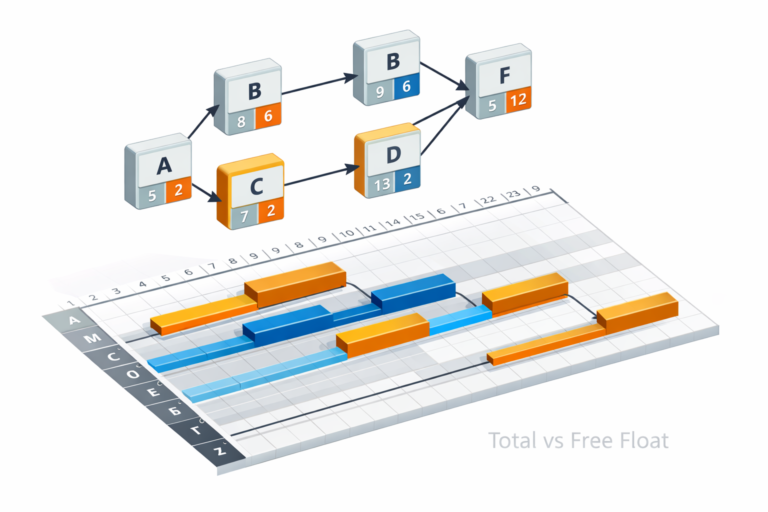
- Float Calculation Methods: Total Float vs Free Float in Construction Scheduling
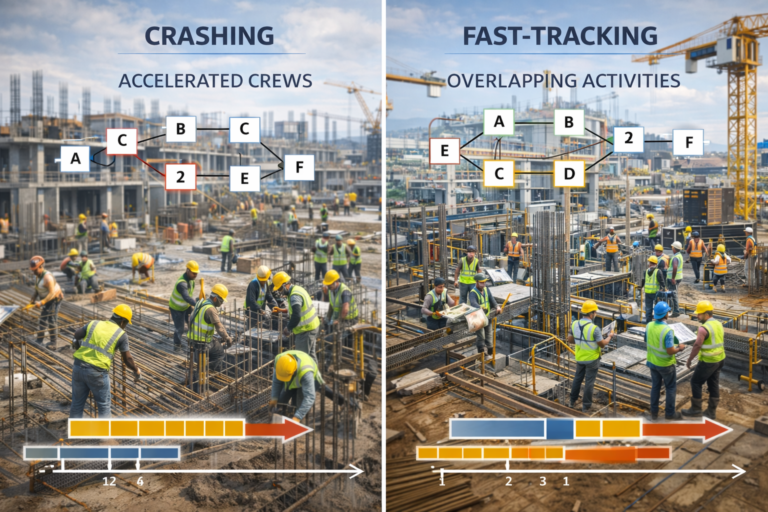
- Schedule Compression Techniques in Construction: Crashing vs Fast-Tracking Explained
- Resource Allocation Strategies in Planning for Construction Projects
10. Frequently Asked Questions (FAQ)
10.1 What is the difference between a claim and a change order?
A change order (or variation) is a mutually agreed modification to scope, price, or time, while a claim is a unilateral demand usually triggered when agreement cannot be reached under normal variation processes.
10.2 How soon must a contractor notify a claim?
Standard forms like FIDIC often require notice within 28 days of becoming aware of the event, though exact periods vary by contract. Teams should always check specific clauses.
10.3 Are all delays compensable?
No. Delays may be excusable but non‑compensable (e.g., exceptional weather) or compensable (e.g., employer variation), and some may be non‑excusable, leading to contractor liability.
10.4 How important are project schedules in claim success?
Approved baseline and updated schedules are critical for demonstrating causal impact on completion and for performing recognized delay analysis methods. Weak or unrealistic schedules undermine claims.
10.5 Can global or total cost claims succeed?
Global claims that simply compare final costs to budget without detailed causation face scepticism and may be reduced or rejected unless data gaps make more precise analysis impossible and causative responsibility is still clearly demonstrated.
10.6 When should a dispute be escalated to arbitration?
Arbitration typically follows exhaustion of contractual dispute mechanisms, such as dispute boards and amicable settlement periods, and is appropriate when issues are high value and negotiation has failed.
10.7 Do digital tools really reduce claims?
Better information flows and coordinated design using digital tools correlate with fewer surprises and claims driven by design errors or late information, although they do not eliminate contractual risk altogether.
11. Conclusion and Key Takeaways
Successful management of construction contract claims depends less on aggressive posturing and more on disciplined contract administration, clear causation analysis, and credible quantification. Teams that invest early in procedures, training, and tools usually experience fewer disputes and better negotiation outcomes.
Key practices include timely notices, robust record keeping, recognized delay and disruption methods, and proactive use of dispute avoidance mechanisms like dispute boards. By treating claims as an integrated risk‑management function rather than a last‑minute legal reaction, construction businesses can protect margins, maintain delivery performance, and strengthen long‑term relationships across the project ecosystem.
For Famcod readers, the principles outlined here provide a practical roadmap to build or refine internal claims management frameworks that work in real construction environments, from local residential projects to international FIDIC‑based infrastructure programs.
12. Free Resources for Construction Teams
- Open‑access university texts on construction contracting and claims, offering practical explanations of claims procedures and contract administration.
- Government and agency guides on contract claims and dispute resolution processes in public projects.
- Industry whitepapers and reports summarizing top causes of disputes and recommended mitigation strategies.
13. Related Articles on Famcod
(Insert internal links to existing or planned Famcod content; sample placeholders below.)
- Construction Contract Management Basics – [Famcod internal link]
- Effective Delay Analysis for Project Managers – [Famcod internal link]
- How to Build a Claims‑Ready Construction Schedule – [Famcod internal link]
- Risk Allocation in EPC and Design‑Build Contracts – [Famcod internal link]
- Site Records That Win Claims – [Famcod internal link]
- Handling Change Orders Without Disputes – [Famcod internal link]
- Top Dispute Resolution Strategies for Contractors – [Famcod internal link]
Each internal article should naturally reference the primary keyword construction contract claims at least once.
14. Recommended Resources (Books & Courses – Affiliate)
Books (Amazon Affiliate)

Courses (Coursera Affiliate)
About the Author