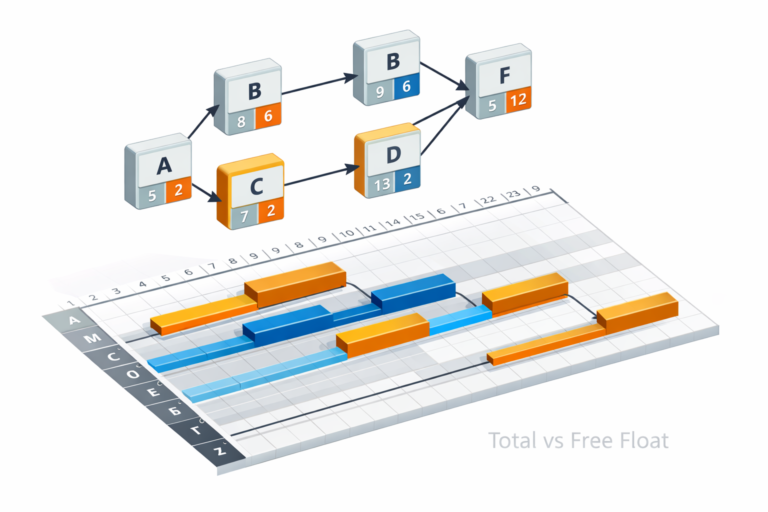
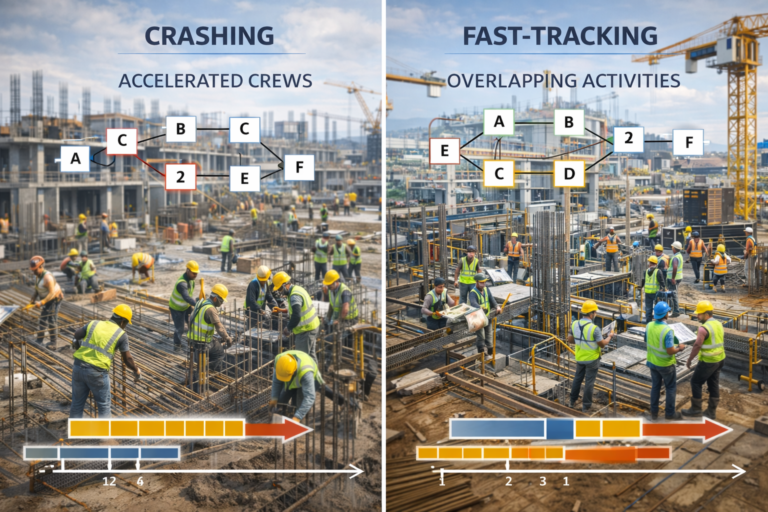
PERT three-point estimation gives planners a structured way to handle this uncertainty instead of pretending it does not exist.
Using optimistic, most likely, and pessimistic durations for each activity, PERT converts subjective experience and risk into a quantitative, schedule-ready number. This method is especially useful when tasks are complex, new, or heavily dependent on external approvals, as is common in modern construction.
When used correctly, PERT three-point estimation improves the logic and credibility of the baseline programme, helps justify contingencies to clients, and supports probabilistic risk analysis on key milestones.
Table of Contents
2. Why PERT Three-Point Estimation matters in construction
Construction projects often suffer time overruns of 10–30% on large infrastructure and building works due to poor estimation, scope changes, and underestimated risks. Traditional single-point duration estimates (for example “28 days for foundations”) assume a certainty that does not exist in real job sites.
PERT three-point estimation helps you:
- Capture uncertainty explicitly by recording best-case, expected, and worst-case durations for each activity.
- Quantify schedule risk using expected duration and variance instead of vague “buffer days”.
- Support claims and negotiations with mathematically grounded arguments when delays occur, linking back to original assumptions.
For design–build, EPC, and fast-track projects, adopting three-point estimation improves coordination between design, procurement, and construction teams. It also makes critical-path analysis more realistic by reflecting variability on high-risk activities like facade installation, MEP coordination, and commissioning.
3. Fundamental concepts of PERT three-point estimation
3.1 Three time estimates
PERT three-point estimation uses three duration estimates for each activity:
- Optimistic time (O) – Shortest time if everything goes well (no major delays, high productivity).
- Most likely time (M) – Best realistic estimate under normal conditions.
- Pessimistic time (P) – Longest reasonable time if major issues occur (delays, rework, disruptions).
These three values define a range and shape for the possible duration of the activity.
3.2 Expected duration (PERT beta)
PERT typically assumes durations follow a beta distribution, a flexible probability distribution that can be skewed to reflect that extremely optimistic or pessimistic durations are less likely. The expected time E is calculated as a weighted average:E=6O+4M+P
This formula gives more weight to the most likely estimate while still considering optimistic and pessimistic scenarios.
3.3 Variance and standard deviation
The uncertainty around an activity is captured using standard deviation σ and variance σ2.σ=6P−Oσ2=(6P−O)2
A larger difference between pessimistic and optimistic durations means higher variability and therefore higher schedule risk.
3.4 Triangular vs PERT distribution
Some planners use a triangular distribution, where the expected duration is simply the average:Etriangular=3O+M+P
In construction, the PERT (beta) formula is usually preferred because it better reflects that the most likely value has higher probability, giving more realistic expected durations for planning and risk analysis.
4. Core formulas and variance calculations
4.1 Core PERT formulas (summary)
4.2 Critical path and project variance
If activities on the critical path are assumed independent, the expected project duration is the sum of expected times on the critical path:Eproject=∑Ecritical activities
The project variance along the critical path is the sum of variances:σproject2=∑σcritical activities2σproject=σproject2
4.3 Probability of meeting a deadline
To estimate the probability of completing the project by a target date Ts, use the Z-score:Z=σprojectTs−Eproject
Then use the standard normal distribution table (or software) to find the completion probability for that Z value. This is powerful for construction contract negotiations where a client asks, “What is the probability of finishing by 30 November?”.
4.4 Comparison table: PERT vs Triangular
5. Step-by-step methodology for construction schedulers
5.1 Checklist: When to apply PERT
Use PERT three-point estimation for activities that are:
- On or near the critical path.
- High risk (interfaces, approvals, complex installations).
- New or not backed by strong historical data.
- Weather-sensitive or heavily subcontractor-dependent.
This focuses effort on the activities that matter most to the overall completion date.
5.2 Step 1 – Break down work (WBS and activities)
- Develop or refine the Work Breakdown Structure (WBS).
- Convert WBS elements into discrete activities with clear start and finish definitions (e.g., “Level 3 slab formwork and reinforcement completed”).
- For each activity, confirm constraints: access, approvals, design freeze, utilities, and procurement.
A clear scope for each activity reduces estimation noise and makes optimistic, most likely, and pessimistic values more meaningful.
5.3 Step 2 – Collect three-point estimates
- Bring in site engineers, foremen, subcontractors, and planners.
- Ask them separately for O, M, and P for each activity in working days, assuming consistent resource loading.
- Challenge extreme values:
- If P is more than 2–3 times M, check whether the scope is wrongly defined.
- If O is equal to M, ask whether any positive risk or productivity improvements exist.
The goal is to capture realistic extremes, not impossible outliers.
5.4 Step 3 – Apply PERT formulas
For each activity:
- Compute expected duration E=6O+4M+P.
- Compute standard deviation σ=6P−O.
- Compute variance σ2=(6P−O)2.
These values will feed into your scheduling tool and risk analysis model.
5.5 Step 4 – Build and analyze the network
- Enter expected durations into your scheduling tool (Primavera P6, MS Project, etc.).
- Define logical relationships (FS, SS, FF, lags) based on construction sequencing.
- Run critical path calculation and note the critical activities and path duration.
- Sum variances on the critical path to get project variance and standard deviation.
5.6 Step 5 – Run deadline probability checks
- Set contractual completion date or key milestone date as target Ts.
- Compute Z-score Z=σprojectTs−Eproject.
- Use normal distribution tables or software to find the completion probability.
- Present this to stakeholders as a risk-informed view of the programme, and adjust contingency or resource loading accordingly.
5.7 Checklist: Embedding into your workflow
- Include O, M, P, E, σ columns in your estimation sheets.
- Review high-variance activities at weekly planning meetings.
- Use updated information as the project progresses to recalibrate estimates.
- Integrate output into risk registers and monthly reports.
6. Worked Example 1: Concrete pour activity
6.1 Scenario
Activity: Ground floor slab (formwork, rebar, embedments, pour, finish) for a mid-rise commercial building. Key uncertainties: rebar congestion, inspection availability, pump breakdown, and weather.
Site team provides the following duration estimates (in working days):
- Optimistic (O): 8 days (no inspection delays, good rebar productivity, no rain).
- Most likely (M): 12 days (normal minor fixes, typical productivity).
- Pessimistic (P): 18 days (inspection rescheduling, extra rebar, weather interruptions).
6.2 PERT calculations
Expected duration:E=68+4×12+18=68+48+18=674≈12.33 days
Standard deviation:σ=6P−O=618−8=610≈1.67 days
Variance:σ2=1.672≈2.78 days2
The planner uses 12.5 days as the scheduled duration, understanding that there is built-in recognition of potential delay.
6.3 Practical interpretation
- Duration under 10 days has relatively low probability.
- Duration beyond 18 days should occur only in very rare, extreme scenarios; if such delays become common, the estimates or risk assumptions need revisiting.
This type of activity-level analysis can be repeated across all critical pours (podium, typical floors, roof slab) and aggregated to see how concrete work affects the project completion probability.
7. Worked Example 2: High-risk MEP coordination
7.1 Scenario
Activity: MEP coordination and shop drawings for six floors in a hospital project with complex medical gas, HVAC, and IT systems. Uncertainties involve design freezes, RFIs, and client review cycles.
Durations in weeks:
- Optimistic (O): 4 weeks (design inputs complete, fast approvals).
- Most likely (M): 7 weeks.
- Pessimistic (P): 13 weeks (multiple design revisions and additional coordination rounds).
7.2 PERT calculations
Expected duration:E=64+4×7+13=64+28+13=645=7.5 weeks
Standard deviation:σ=613−4=69=1.5 weeks
Variance:σ2=1.52=2.25 weeks2
7.3 Impact on project schedule
If this activity sits on the critical path, its high variance (2.25 weeks²) indicates a major schedule risk. Combining its variance with other critical activities can show that even if the baseline targets are aggressive, the probability of hitting the commissioning date may be significantly below 50%.
Planners can use this insight to justify:
- Early engagement with designers and client representatives.
- Parallel workstreams or additional coordination resources.
- More realistic milestone dates in the contract programme.
8. Advanced applications in complex construction projects
8.1 Probabilistic completion date analysis
By summing variances across critical path activities and computing Z-scores for different target dates, planners can generate S-curves showing completion probability versus date. This is often used alongside Monte Carlo simulations in advanced risk software.
Instead of a single completion date, management can see, for example: “There is a 70% chance of completing by 15 October and a 90% chance by 10 November.” This guides contingency planning, resource allocation, and contract negotiations.
8.2 Integrating with Monte Carlo simulation
Many schedule risk analysis tools use PERT or similar distributions for each activity and then simulate thousands of possible project outcomes. Three-point estimates provide the input for these activity distributions, making Monte Carlo outputs grounded in practical site experience.
Benefits include:
- Identifying which activities drive most of the schedule risk (“risk drivers”).
- Quantifying the probability that liquidated damages milestones are missed.
- Evaluating different mitigation options (e.g., double shifts, prefabrication).
8.3 Linking PERT to cost and cash flow
Three-point estimation can also be applied to cost, not just time. Activities with uncertain quantities, productivity, or unit rates can have optimistic, most likely, and pessimistic cost estimates, and PERT can provide expected cost and variance.
This supports:
- Contingency allowances in project budgets.
- Risk-adjusted cash flow projections.
- Value engineering decisions prioritizing high-risk, high-impact items.
8.4 Interface and handover management
Interface tasks, such as utility connections, authority inspections, and third-party approvals, are often high-variance activities. Capturing their three-point estimates allows planners to explicitly show how external parties influence time risk.
9. Tools & software for PERT in construction
9.1 Mainstream scheduling tools
- Primavera P6 – Widely used on large construction projects, supports activity-level duration fields, custom columns (O, M, P), and integration with risk add-ons.
- Microsoft Project – Suitable for small to medium projects; can store three-point data in custom fields and export to Excel or risk tools.
While these tools do not always calculate PERT automatically out of the box, custom fields and formulas can be configured to compute expected durations and variances.
9.2 Risk analysis add-ons
- Schedule risk software often supports PERT distributions, activity sampling, and Monte Carlo simulations based on three-point inputs.
- These tools generate completion probability curves, criticality indices, and sensitivity analyses, all fed by PERT parameters.
9.3 Spreadsheet templates
Many teams maintain Excel templates to calculate PERT values:
- Columns for Activity ID, Description, O, M, P, E, σ, σ².
- Conditional formatting to flag high-variance activities.
- Export/import links with scheduling tools via CSV.
Simple spreadsheet-based PERT is often a practical starting point before investing in full schedule risk tools.
10. Common mistakes and how to fix them
10.1 Treating PERT as “just another duration”
Mistake: Using the expected time E but ignoring variance and standard deviation.
Solution: Always compute and review σ and σ2 to identify high-risk activities; integrate them into risk analysis and reporting.
10.2 Unrealistic optimistic and pessimistic values
Mistake: Setting optimistic and pessimistic durations too close to the most likely value, which underestimates risk.
Solution: Facilitate workshops using historical data and lessons learned to calibrate realistic best- and worst-case durations.
10.3 Ignoring correlation between activities
Mistake: Assuming all activity durations are independent when many share risk drivers (e.g., weather, key subcontractor performance).
Solution: For high-level risk analysis, acknowledge correlated risks in simulations and scenario planning; consider grouping correlated activities.
10.4 Using PERT on every minor activity
Mistake: Applying full three-point estimation to trivial, non-critical tasks, wasting effort.
Solution: Focus PERT on critical and near-critical activities and on packages with high uncertainty.
10.5 No periodic update of estimates
Mistake: Keeping original three-point estimates unchanged even after gaining more information mid-project.
Solution: Update O, M, P for remaining work at key milestones (e.g., after design freeze, procurement award, or major change orders). This keeps risk models aligned with reality.
10.6 Checklist: Good practice in PERT
- Capture O, M, P via multi-disciplinary workshops.
- Validate estimates against past projects.
- Flag and discuss high-variance activities.
- Communicate results clearly to stakeholders using visuals and simple narratives.
11. Real-World Case Study 1: Hospital expansion project
11.1 Background
A contractor is building a five-storey hospital extension adjacent to a live facility. Key constraints include noisy work restrictions, infection control, and strict handover dates to align with equipment deliveries. PERT three-point estimation is applied to about 60 critical and near-critical activities.
11.2 Application of three-point estimation
High-risk activities analyzed include:
- Structural steel erection over existing areas.
- MEP coordination and commissioning of operating theaters.
- Integration of new services with existing hospital systems.
For example, operating theater commissioning has estimates:
- O = 12 days (no major balancing issues).
- M = 18 days.
- P = 32 days (multiple retesting and authority re-inspections).
Using PERT:E=612+4×18+32=612+72+32=6116≈19.33 daysσ=632−12=620≈3.33 days
Variance ≈ 11.11 days², indicating a very high-risk activity.
11.3 Outcomes
By aggregating variances across critical activities, the project team realized that the probability of meeting the original handover date was below 40%. Management used this analysis to:
- Secure pre-commissioning access earlier from the client.
- Increase commissioning resources and extend working hours in the final phase.
- Negotiate minor adjustments to non-critical milestones rather than major claims later.
The project ultimately achieved handover within a few days of the target, with significantly fewer disputes because expectations were risk-informed from the start.
12. Real-World Case Study 2: High-rise residential tower
12.1 Background
A developer is building a 30-storey residential tower with podium parking and retail at ground. The contractor uses PERT three-point estimation on key repetitive activities such as floor cycles and facade installation.
12.2 Application to floor cycle times
For a typical residential floor structure, durations in days:
- O = 5 days.
- M = 7 days.
- P = 11 days (includes potential rework and crane downtime).
PERT values:E=65+4×7+11=65+28+11=644≈7.33 daysσ=611−5=1.0 dayσ2=1.0
For 20 typical floors on the critical path, expected duration is about 20×7.33=146.6 days, with total variance of 20×1=20 days² and standard deviation 20≈4.47 days.
12.3 Facade installation risk
Three-point estimates for facade panels per floor:
- O = 6 days.
- M = 9 days.
- P = 16 days.
PERT:E=66+4×9+16=66+36+16=658≈9.67 daysσ=616−6≈1.67 daysσ2≈2.78 days2
12.4 Outcomes
The PERT-based analysis showed that facade installation contributed a disproportionate share of schedule variance compared to structure. This led to:
- Early mock-ups and design freeze.
- Increased off-site prefabrication.
- A revised sequence allowing partial handovers of lower floors while upper facades continued.
Using PERT three-point estimation, the team improved confidence in the completion date and reduced exposure to delay penalties.
13. FAQ: PERT three-point estimation in construction
13.1 Is PERT three-point estimation only for large projects?
No. While PERT was originally used on large, complex programs, it is equally valuable on small and medium projects for critical activities with high uncertainty.
13.2 What is the difference between three-point estimation and PERT?
Three-point estimation simply uses optimistic, most likely, and pessimistic values, and may use different averaging schemes like the simple mean. PERT is a specific application that usually uses the beta distribution and the formula E=(O+4M+P)/6, plus variance and probability analysis.
13.3 Do all activities need three-point estimates?
No. In practice, only critical and near-critical or high-risk activities should receive full three-point analysis, while minor tasks use single-point estimates. This keeps the process manageable while still improving schedule realism.
13.4 How accurate is PERT compared to traditional estimation?
PERT tends to provide more realistic expectations because it explicitly includes downside and upside risk rather than assuming a single deterministic duration. Accuracy still depends on the quality of input estimates and experience of the team.
13.5 Can PERT be used for cost estimation in construction?
Yes. The same three-point logic applies to cost: optimistic (low), most likely, and pessimistic (high) cost estimates for items with high uncertainty, such as provisional sums or uncertain quantities.
13.6 How often should three-point estimates be updated?
Estimates should be revisited at major project milestones (e.g., design freeze, major package award, substantial completion of preceding work) and when significant risks are resolved or new ones appear.
13.7 Is PERT compatible with critical path method (CPM) schedules?
Yes. PERT complements CPM by providing probabilistic durations instead of purely deterministic ones. The network logic is the same; PERT simply refines how durations and risks are handled.
14. Free resources for construction planners
Construction professionals looking to deepen skills in PERT three-point estimation and risk-based scheduling can explore:
- Free online articles and blogs explaining PERT formulas, three-point estimation, and schedule risk analysis for project managers.
- Video lectures and tutorials on PERT, CPM, and probability-based scheduling, useful for revising fundamentals and visualizing networks.
- Open-access tools and spreadsheets shared by practitioners that implement three-point estimation and PERT calculations.
15. Conclusion and next steps
PERT three-point estimation in construction scheduling provides a structured, mathematically grounded way to deal with the uncertainty that dominates real job sites. By capturing optimistic, most likely, and pessimistic durations, planners transform expert judgment into expected times and variances that can be incorporated into CPM schedules and risk models.
Using the PERT formulas E=(O+4M+P)/6 and σ=(P−O)/6, construction teams can identify high-risk activities, focus resources on critical interfaces, and quantify the probability of meeting key milestones. This leads to more robust baseline programmes and clearer communication with clients and stakeholders.
To embed PERT three-point estimation in everyday practice, project teams should introduce simple templates for O–M–P data capture, run regular workshops with engineers and subcontractors, and link outputs directly to scheduling and risk-reporting tools. Over time, the organization can build a knowledge base of realistic ranges for typical activities, improving estimation accuracy on future projects.
For construction professionals, adopting PERT three-point estimation is not just a mathematical exercise; it is a practical way to reduce surprises, strengthen project controls, and protect margins in an industry where time truly is money.
About the Author