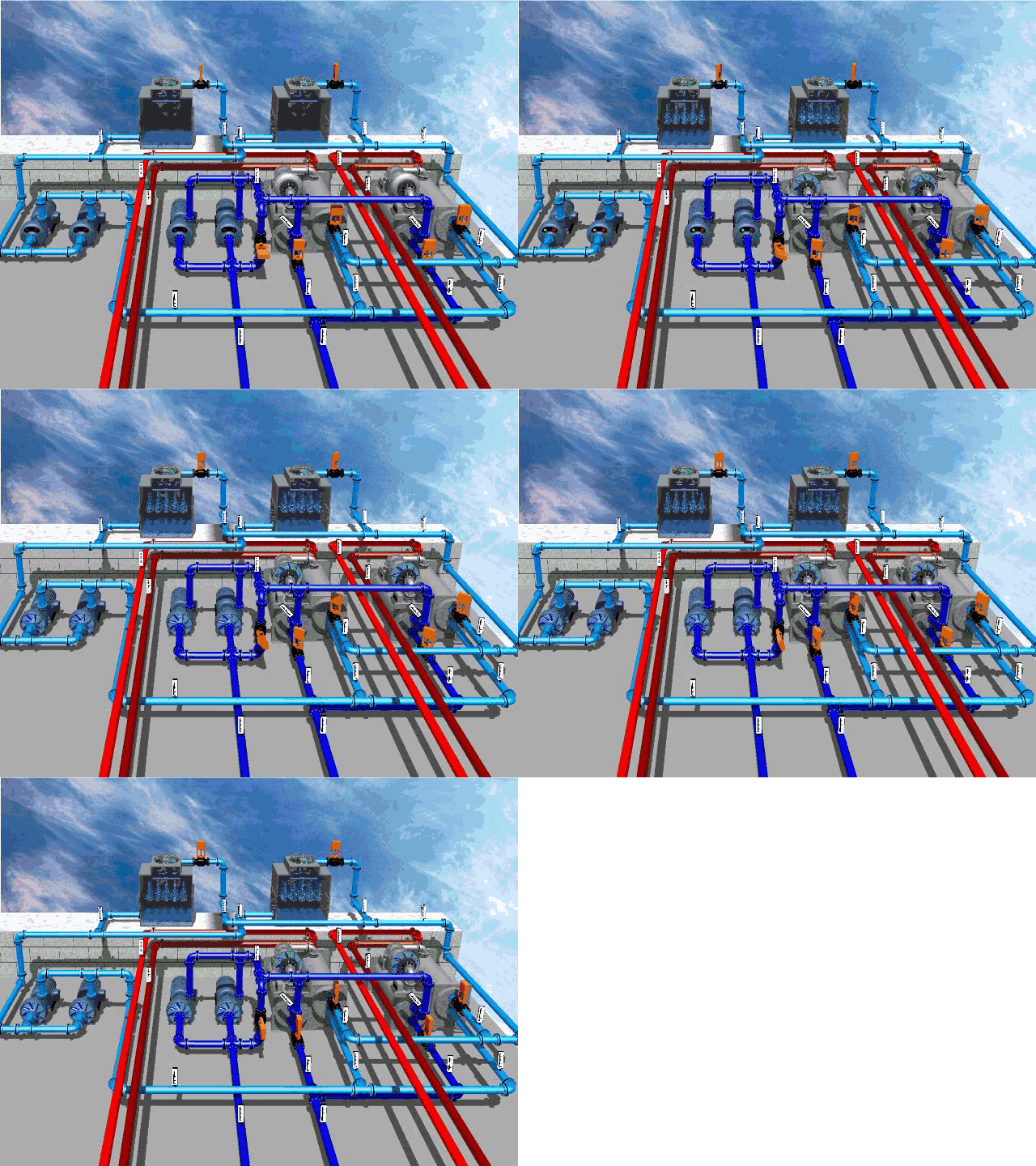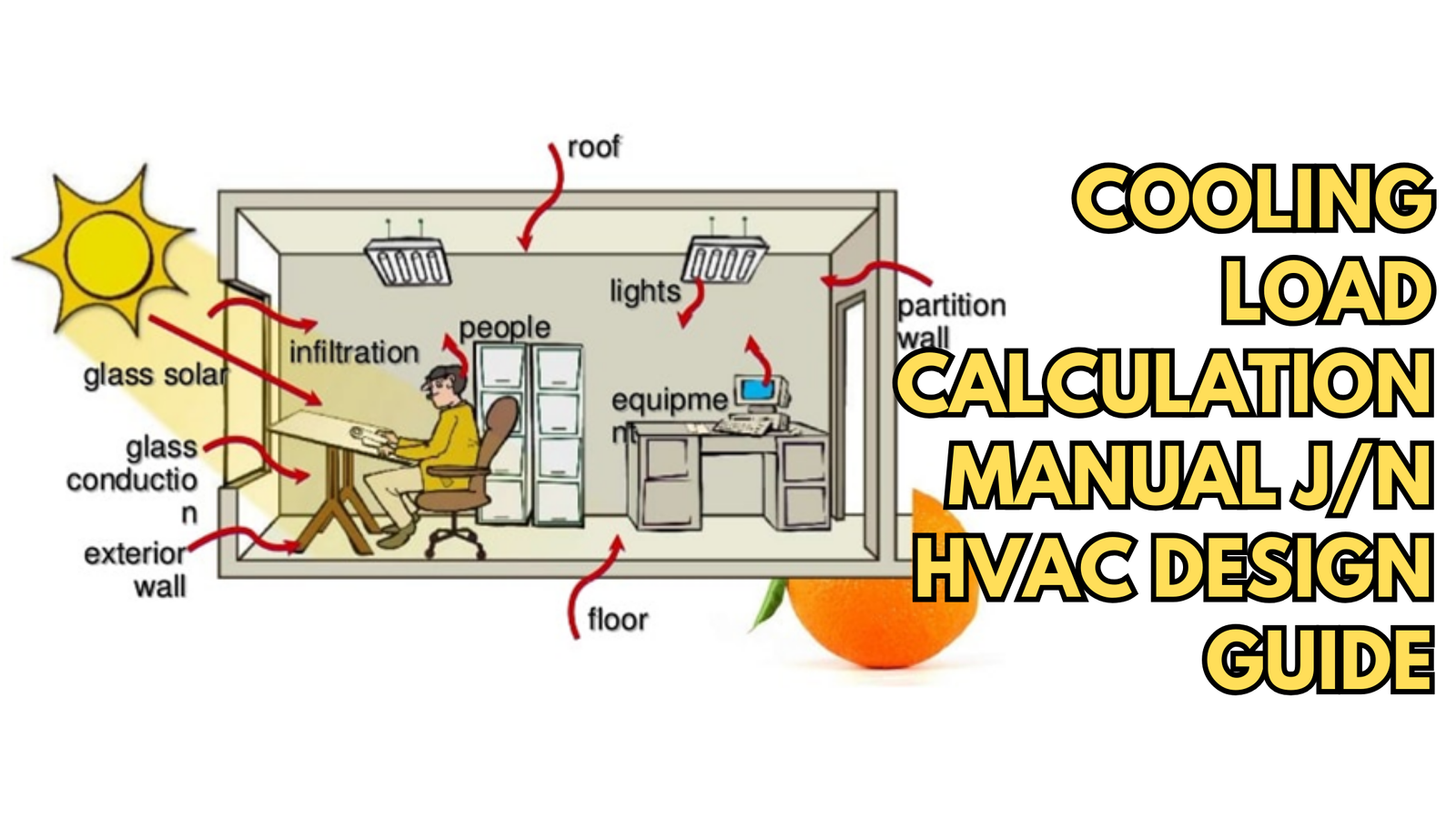
Cooling load calculation Manual J/N – illustration of internal and external heat gains for HVAC design
Introduction to Cooling Load Calculations
Cooling load calculation is the cornerstone of HVAC system design. An accurate cooling load determines the exact tonnage (BTUH) capacity required for proper building comfort, preventing both oversizing (short cycling, poor humidity control) and undersizing (inadequate cooling, occupant discomfort).
Two industry-standard methods dominate:
- Manual J (ACCA): Residential buildings (<5,000 sq ft)
- Manual N (ACCA): Commercial buildings (>5,000 sq ft)
This comprehensive 2,500+ word guide covers both methods in depth, with worked examples, software recommendations, common mistakes, and real-world case studies. Whether you’re designing a single-family home or a 50,000 sq ft office building, you’ll master the calculations needed for professional HVAC design.
Manual J vs Manual N Cooling Load Calculation Methods Comparison – Residential vs Commercial HVAC Design
Table of Contents
Manual J vs Manual N: Residential vs Commercial
Manual J and Manual N represent fundamentally different approaches to cooling load calculation, optimized for their respective building types.
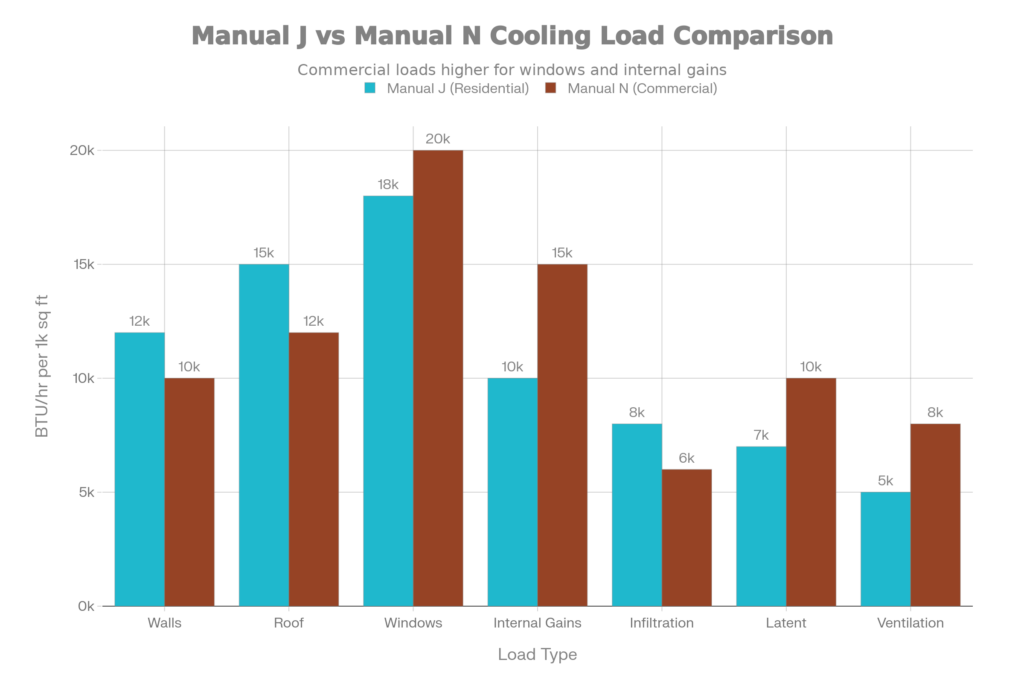
Manual J vs Manual N Cooling Load Calculation Methods Comparison – Residential vs Commercial HVAC Design
Manual J (Residential):
- Room-by-room analysis (detailed)
- Whole-house diversity factors (not all rooms peak simultaneously)
- Simplified inputs (fewer variables)
- Focus: Walls, roof, windows, infiltration, internal gains
- Typical time: 4–8 hours per house
- Software: Wrightsoft Right-Suite, CoolCalc, Manual J 8th Edition
Manual N (Commercial):
- Zone-by-zone analysis (complex)
- Diversity factors (different zones peak at different times)
- Process loads (equipment, lighting, occupancy)
- Fenestration solar gains (detailed glazing calculations)
- Typical time: 20–40 hours per building
- Software: TRACE 700, HAP, EnergyPlus
Visual Comparison:
Manual J Residential Cooling Load Calculation
Manual J (8th Edition, ACCA) is the gold standard for residential HVAC sizing. It calculates sensible (temperature) and latent (humidity) loads room-by-room, then applies diversity factors for whole-house equipment sizing.
Manual J Heat Load Components (Typical Residential Breakdown)
| Component | % of Total Load | Description |
|---|---|---|
| Roof/Ceiling | 25% | Solar gain through roof + conduction |
| Walls | 20% | Exterior wall conduction + solar gain |
| Windows/Glazing | 15% | Solar heat gain coefficient (SHGC) + conduction |
| Infiltration | 10% | Air leakage through building envelope |
| Internal Gains (People) | 8% | Occupant sensible + latent heat |
| Appliances/Equipment | 10% | Cooking, lighting, electronics |
| Latent Loads | 5% | Moisture from people, cooking, infiltration |
| Duct Losses | 7% | Supply/return duct leakage & conduction |
Manual J Calculation Methodology
Step 1: Building Geometry
Room-by-room dimensions (L × W × H)
Ceiling heights (sloped roofs = average height)
Window locations & sizes
Door locations & types
Orientation (N/S/E/W)
Step 2: Envelope Construction
Wall U-factor (R-value)
Roof U-factor (attic insulation)
Window SHGC & U-factor
Infiltration (blower door test or default)
Duct location (conditioned/unconditioned space)
Step 3: Internal Loads
Occupancy (people per room)
Lighting (watts per sq ft)
Appliances (cooking, laundry, electronics)
Step 4: Climate Data
Design temperature (1% or 2% cooling DB/WB)
Latitude for solar calculations
Elevation (altitude correction)
Step 5: Room-by-Room Loads
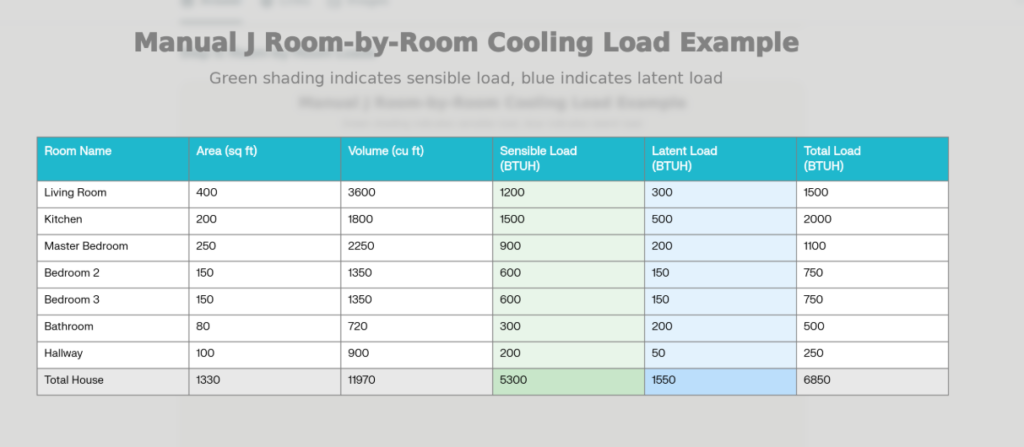
Manual J Room-by-Room Cooling Load Calculation Example – 3-Bedroom House
Sensible Load (BTUH) = Envelope + Internal
Latent Load (BTUH) = People + Infiltration + Appliances
Total Room Load = Sensible + Latent
Step 6: Diversity Factors
Not all rooms peak simultaneously
Apply Manual J diversity tables
Calculate block load for equipment sizing
Manual J Room-by-Room Example
3-Bedroom House Example (1,330 sq ft):
Living Room: 1,200 sensible + 300 latent = 1,500 BTUH
Kitchen: 1,500 sensible + 500 latent = 2,000 BTUH
Master BR: 900 sensible + 200 latent = 1,100 BTUH
Bedroom 2: 600 sensible + 150 latent = 750 BTUH
Bedroom 3: 600 sensible + 150 latent = 750 BTUH
Bathroom: 300 sensible + 200 latent = 500 BTUH
Hallway: 200 sensible + 50 latent = 250 BTUH
TOTAL: 5,300 sensible + 1,550 latent = 6,850 BTUH
Equipment Sizing (with diversity): 3.5 tons (42,000 BTUH)
Manual N Commercial Cooling Load Calculation
Manual N (2nd Edition, ACCA) addresses the complexity of commercial buildings with zone diversity, process loads, and fenestration solar gains.
Manual J vs Manual N Cooling Load Calculation Methods Comparison – Residential vs Commercial HVAC Design
Manual N Key Differences from Manual J
- Zone-based diversity (not all zones peak together)
- Process loads (manufacturing, cooking, data centers)
- Fenestration solar heat gain (detailed glazing calculations)
- Ventilation loads (ASHRAE 62.1 compliance)
- Lighting power density (watts/sq ft)
- Receptacle loads (plug loads)
Manual N Heat Load Components
| Component | Residential (Manual J) | Commercial (Manual N) |
|---|---|---|
| Walls | U-factor × area × ΔT | U-factor × area × ΔT + solar gain |
| Roof | U-factor × area × ΔT | U-factor × area × ΔT + solar |
| Windows | SHGC × solar factor | SHGC × cooling load factor (CLF) |
| Infiltration | ACH × volume | ACH × volume + stack effect |
| People | Sensible + latent/person | Sensible + latent × diversity |
| Lights | Watts × utilization factor | Watts/sq ft × CLF |
| Equipment | Fixed BTUH/appliance | Process loads + diversity |
| Ventilation | Minimal | ASHRAE 62.1 required |
Manual N Zone Load Example: Office Building
Zone 1: Executive Office (250 sq ft)
Envelope Loads: 4,500 BTUH
People (1 person): 250 sensible + 200 latent
Lights (2.0 W/sq ft): 500 BTUH
Receptacles (1.0 W/sq ft): 250 BTUH
Ventilation (ASHRAE 62.1): 75 CFM = 3,000 BTUH
TOTAL ZONE LOAD: 8,700 BTUH
Zone Diversity Calculation:
Peak simultaneous load = 65% of total zone loads
Office total block load = 65% × sum(all zone loads)
Heat Transfer Mechanisms Explained
1. Conduction Heat Gain (Q = U × A × ΔT)
Conduction through opaque surfaces:
Q_cond = U-factor × Area × Temperature Difference
U-factor: BTUH/sq ft/°F (inverse of R-value)
ΔT: Indoor temp - Outdoor design temp
Example: Brick wall
U = 0.20 BTUH/sq ft/°F
Area = 400 sq ft
ΔT = 95°F outdoor - 75°F indoor = 20°F
Q = 0.20 × 400 × 20 = 1,600 BTUH
2. Solar Heat Gain Through Windows (SHGC)
Solar Heat Gain Coefficient (SHGC):
Q_solar = SHGC × Area × Solar Heat Gain Factor (SHGF)
SHGC: 0.25 (low-e) to 0.80 (single pane)
SHGF: Depends on orientation, latitude, time
Example: South-facing double-pane window:
SHGC = 0.40
Area = 50 sq ft
SHGF (Miami, 2 PM, summer) = 180 BTUH/sq ft
Q = 0.40 × 50 × 180 = 3,600 BTUH
3. Infiltration Heat Gain
Infiltration load calculation:
Q_inf = 1.08 × CFM × ΔT
1.08 = Specific heat × density × 60 min/hr
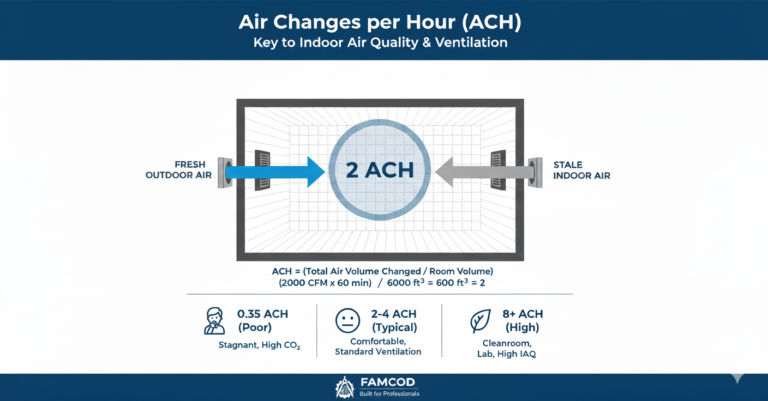
CFM = Infiltration air changes × Volume ÷ 60
Example: Leaky bedroom (4 ACH):
Volume = 1,200 cu ft
CFM = 4 × 1,200 ÷ 60 = 80 CFM
ΔT = 20°F
Q = 1.08 × 80 × 20 = 1,728 BTUH
4. Internal Heat Gains
Occupancy loads (ASHRAE):
Office worker: 250 BTUH sensible + 200 BTUH latent
Restaurant: 400 sensible + 550 latent
Manufacturing: 350 sensible + 250 latent
Lighting loads:
Q_light = Watts × 3.41 BTUH/watt × Utilization factor
3.41 = Watts to BTUH conversion
Utilization: 0.8 (typical fluorescent/LED)
Equipment loads:
Computers: 300–500 BTUH each
Copiers: 2,000 BTUH
Kitchen equipment: 5,000–20,000 BTUH
Step-by-Step Manual J Calculation (Complete Example)
Example House: 2,000 sq ft, 3BR/2BA, Phoenix AZ
Step 1: Gather Building Data
Climate: Phoenix (95°F design DB, 72°F WB)
Insulation: R-30 attic, R-13 walls, double-pane windows (SHGC 0.30)
Infiltration: 0.5 ACH natural (blower door verified)
Occupancy: 4 people
Appliances: Standard (refrigerator, range, dishwasher)
Step 2: Room-by-Room Geometry
Living Room: 20×20×10 = 4,000 cu ft
Kitchen: 15×12×10 = 1,800 cu ft
Master BR: 15×15×9 = 2,025 cu ft
BR2/BR3: 12×12×9 = 1,296 cu ft each
Bathrooms: Combined 800 cu ft
Hall: 400 cu ft
TOTAL VOLUME: 11,970 cu ft
Step 3: Calculate Envelope Loads
Roof/Ceiling (R-30 attic):
Area = 2,000 sq ft
U = 1 ÷ 30 = 0.033 BTUH/sq ft/°F
Ceiling ΔT = 30°F (attic 125°F)
Q_ceiling = 0.033 × 2,000 × 30 = 1,980 BTUH
Walls (R-13, 400 sq ft exposed):
U = 1 ÷ 13 = 0.077 BTUH/sq ft/°F
ΔT = 20°F
Q_walls = 0.077 × 400 × 20 = 616 BTUH
Windows (200 sq ft, SHGC 0.30):
Solar gain (Phoenix summer): 180 BTUH/sq ft
Q_windows = 0.30 × 200 × 180 = 10,800 BTUH
Conduction: U=0.35 × 200 × 20 = 1,400 BTUH
TOTAL WINDOWS: 12,200 BTUH
Step 4: Internal & Infiltration Loads
Infiltration (0.5 ACH):
CFM = 0.5 × 11,970 ÷ 60 = 100 CFM
Q_sensible = 1.08 × 100 × 20 = 2,160 BTUH
Q_latent = 4,840 × 100 × 0.0004 = 193 BTUH
Occupancy (4 people):
Sensible: 4 × 230 = 920 BTUH
Latent: 4 × 200 = 800 BTUH
Appliances/Lights:
Lights: 2,000 sq ft × 1.2 W/sq ft × 3.41 × 0.8 = 6,540 BTUH
Appliances: 3,000 BTUH fixed
TOTAL INTERNAL: 11,260 BTUH
Step 5: Total Block Load
Envelope: 14,796 BTUH
Infiltration: 2,353 BTUH
Internal: 11,260 BTUH
TOTAL: 28,409 BTUH
Diversity factor: 85%
FINAL EQUIPMENT SIZE: 24,148 BTUH = 2.0 tons
Software Tools Comparison
Residential Software (Manual J Compliant)
| Software | Cost | Features | Learning Curve | Best For |
|---|---|---|---|---|
| Wrightsoft Right-Suite | $1,995 | Full Manual J/N, duct design | Medium | Professional contractors |
| CoolCalc Manual J | $495 | Cloud-based, fast | Easy | Small contractors |
| Elite RHVAC | $995 | ACCA approved | Medium | Engineering firms |
| Manual J 8th Ed (Excel) | Free/$50 | Spreadsheet version | Hard | DIY/advanced users |
Commercial Software (Manual N Compliant)
| Software | Cost | Features | Learning Curve | Best For |
|---|---|---|---|---|
| Trane TRACE 700 | $2,500+ | Full Manual N, energy modeling | Hard | Engineering firms |
| Carrier HAP | $3,000+ | ASHRAE loads + energy | Hard | Large commercial |
| EnergyPlus | Free | DOE research tool | Very Hard | Advanced users |
| IES VE | $5,000+ | BIM integration | Hard | Architects/engineers |
Recommended for Famcod Users: Start with CoolCalc Manual J ($495) for residential + TRACE 700 trial for commercial learning.
Common Mistakes & Solutions
Mistake 1: Using Peak Sun Instead of Design Conditions
❌ Wrong: Assume all windows peak solar simultaneously
✅ Correct: Use Cooling Load Temperature Difference (CLTD) tables
Mistake 2: Ignoring Duct Losses
❌ Wrong: 20% duct loss in unconditioned attic
✅ Correct: Add 15–25% to block load for duct losses
Mistake 3: Oversizing by Rule of Thumb
❌ Wrong: 1 ton per 400 sq ft (outdated)
✅ Correct: Manual J/N calculation (±5% accuracy)
Mistake 4: Single-Zone Commercial Calculation
❌ Wrong: Treat 10,000 sq ft office as single zone
✅ Correct: Zone-by-zone with diversity factors
Mistake 5: Wrong Climate Data
❌ Wrong: Use 85°F design temp in Phoenix
✅ Correct: 1% design: 104°F DB / 74°F WB
Amazon Affiliate Products & Books
Essential HVAC Load Calculation Books



HVAC Design Tools & Software

Case Studies
Case Study 1: Oversized AC Disaster (Phoenix Home)
Original: Rule-of-thumb 5 tons installed
Actual Manual J: 2.8 tons required
Result: Short cycling, 65% humidity, $800/mo bills
Solution: Replaced with 3-ton + dehumidifier
Savings: $450/mo energy + comfort improvement
Case Study 2: Commercial Undersizing (Office Building)
textOriginal: 80 tons (estimated)
Manual N calculation: 115 tons required
Result: 15°F above setpoint, employee complaints
Solution: Added 35 tons capacity
ROI: Eliminated productivity losses ($25K/year)
FAQs
Q: Manual J or Manual N for 4,000 sq ft office?
A: Manual N (commercial >3,000 sq ft typically requires commercial method)
Q: Can I use free software for Manual J?
A: Yes, ACCA-approved Excel spreadsheets available (~$50), but professional software recommended for liability.
Q: How accurate are load calculations?
A: ±5–10% with proper inputs; field verification recommended.
About the Author